|
The word diversity can mean a lot of things in the world of plants, especially when we talk about diversity within a genus. Plants are grouped taxonomically based on their shared characteristics, so plants within the same genus by definition are similar in many regards. They may differ in mature size or flower color, but for the most part their parts look the same, and they generally like the same soil conditions and sun exposure. Hibiscus, for example, is a genus where the shape of the flower is incredibly consistent throughout the most prominent species within the genus (though color and size may fluctuate) as it leaf shape (again, size and color fluctuate). However, I consider the genus to be fairly diverse because of the range of cold hardiness and growth habits within the genus. Here at the Pitt County Arboretum, we have Hibiscus syriacus, also known as Rose of Sharon, which is a medium sized shrub; Hibiscus coccineus, also called Swamp Hibiscus or Texas Star, a cold hardy perennial that dies back to the ground each winter; Hibiscus sabdariffa, also called Rozelle, a borderline hardy herbaceous plant that is normally treated like an annual in our area; and Hibiscus rosa-sinensis, a tropical hibiscus, a cold sensitive flowering shrub that we grow in pots and bring indoors to overwinter. Of these, it is the Rose of Sharon that has my attention at the moment, as there are two growing here at the Arboretum in full bloom, one white with red centers, and the other bright pink with a darker pink center. I also have two blooming in my yard at home – the same white and red flowering type along my driveway, and a double blooming purple-pink type in the backyard. Individual flowers of Rose of Sharon (and many other Hibiscus) may last for only a day, but new blooms appear continuously over several weeks, creating a prolonged but dynamic floral display. Single flowers are wide bell-shaped, five petaled blossoms, with a prominent fused stamen and pistil poking out through the center. 
prominent fused stamen and pistil. Right: Single, five-petaled pink Rose of Sharon flower, also with a deep red center. Rose of Sharon is a multi-trunked shrub that grows to a height of 8-12’ tall and a spread of about 6-10’. Shrubs can be pruned to grow as a single trunk tree, if desired, with some effort. It grows in sun to part shade, though it will flower best in full sun. It tolerates a wide range of soil types and pH levels, and thrives to some extent on neglect, making it an easy plant to grow. It will struggle in extremely wet or dry soils, but will do well in nearly anything in between.
Though not a native shrub, Rose of Sharon has long been a familiar part of gardens in the Southern and Eastern United States. It can be a bit weedy, and is considered by a few states (Kentucky and Virginia) to be invasive, though North Carolina does not classify it as such. Pollinators, including butterflies, hummingbirds, and a number of bee species, enjoy foraging on its blooms. Matthew Stevens is the County Extension Director and Horticulture Agent for North Carolina Cooperative Extension’s Pitt County Center. If you have questions about this article or gardening in general, please contact the Pitt County Extension Master Gardener Infoline at 252-902-1705.
0 Comments
One of my favorite flowering trees has always been the Eastern redbud, Cercis canadensis. Native to much of Eastern and Central North America, from Canada through Mexico, redbud is one of the earliest trees to bloom in the spring. Despite its name, the flowers are more of a pinkish-purple color, slightly darker when closed in bud, and a bit lighter once fully open. Redbud is part of the legume family, so individual flowers are pea-shaped, and the long seed-pods that develop after bloom concludes resembles many types of beans and peas. Despite its impressive blooms, redbud is not usually eye-catching after flowering is complete. The large heart-shaped leaves are interesting, but not something that necessarily stop you in your tracks. Redbuds prefer part shade and grow naturally in forest edges and under larger trees, so often they’re somewhat hidden later in the year by larger plants, and if they are grown in too much sun, the leaves may burn a bit around the edges. Much plant breeding work has been done in recent years to improve the diversity of redbud cultivars, introducing plants with different leaf colors, growth habits, and flower characteristics. Much of that work has been done by NC State’s Dennis Werner, who is responsible for a great number of new introductions. Some of my favorites include ‘Golden Falls’, ‘Ruby Falls’, ‘Carolina Sweetheart’, ‘Flame Thrower’, and ‘Pink Pom Poms’.
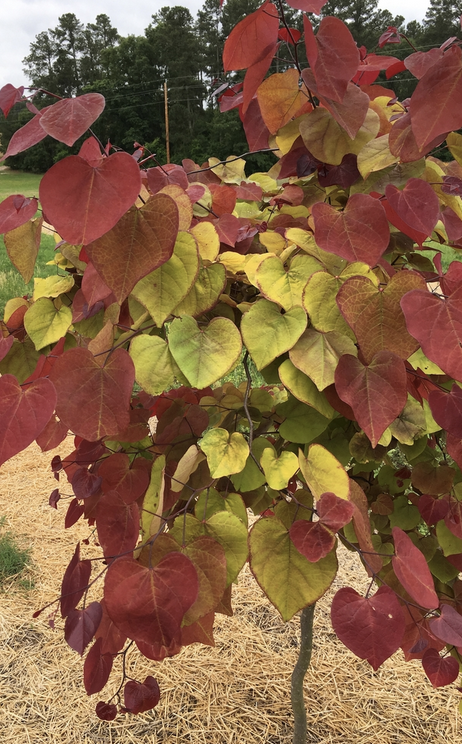
Bottom left: ‘Flame Thrower’ more closely resembles the typical size and shape of a redbud tree, and has unique foliage color. It does not have a naturally weeping habit. Photo: D. Werner, CC BY-NC 4.0 Both ‘Golden Falls’ and ‘Ruby Falls’ are weeping redbud cultivars. Weeping cultivars are typically trained so that the central leader stem grows to a predetermined height, usually about 5-6 feet high, and then the lateral branches which emerge above that height have a naturally weeping habit, spilling downward almost parallel to the trunk. Mature height of each plant is 5-8 feet tall by 3-4 feet wide. ‘Golden Falls’ has brilliant chartreuse foliage, while ‘Ruby Falls’ has burgundy foliage reminiscent of one of its parents, the well-known cultivar ‘Forest Pansy.’
‘Carolina Sweetheart’, and ‘Flame Thrower’ more closely resemble the typical size and shape of a redbud tree, with both height and spread of about 15-30 feet; however, each has unique foliage color. The new leaves of ‘Carolina Sweetheart’ first appear purple each spring, but then change to varying shades and combinations of green, white, and pink, before finally turning solid green by mid-summer. ‘Flame Thrower’ similarly progresses from purple to red to bronze to chartreuse throughout the seasons, with leaves of each color present simultaneously on a single plant. ‘Pink Pom Poms’ is notable not for its foliage, but for its unique blossoms, though its leaves are distinctly smaller and glossier than most redbud types. Each flower is referred to as a double flower because it has twice the number of petals of a standard redbud flower. The impact of these double flowers when this plant is in bloom is extra-striking. Matthew Stevens is the County Extension Director and Horticulture Agent for North Carolina Cooperative Extension’s Pitt County Center. If you have questions about this article or gardening in general, please contact the Pitt County Extension Master Gardener Infoline at 252-902-1705. |
Matt Stevens
Pitt County Extension Director & Horticulture Agent Archives
August 2026
Categories |


 RSS Feed