The Pitt County Arboretum
  • Home
  • What's In Bloom
  • About
    • Staff
    • Master Gardeners
    • Map
    • Stay in Touch
  • Visit
    • Visitor Information
    • Visitor Etiquette
    • Tours
    • Pitt County Agricultural Center
  • Our Gardens
    • Our Gardens
  • Blog
  • Director's Choice
  • Events
    • Calendar
    • Northside Plant Walks
  • Support
    • Plant Sale
    • Friends of the Arboretum >
      • Membership
      • Giving
    • Volunteer
  • Resources
    • Guides
    • Videos
    • Photo Gallery
  • Contact
Week of November 10, 2025
The day before the first frost
By Josie B., Extension Master Gardener Volunteer, Pitt County Extension Office
Even in the middle of November. each garden in the Arboretum has at least a couple of plants in bloom! Leaves are changing colors and falling in today’s cool winds. One flowering plant that is still blooming is gomphrena globosa – Globe Amaranth. It is a beautiful purple color and grows in intense full sun, in partial shade, and in soil that might not be ideal. The plant plays an important role in soil conservation. The blooms are used as a natural dye in textiles. Due to its vibrant long-lasting blooms, Globe Amaranth is known in Greek lore as a symbol of eternal life.
 
The Arboretum is open seven days a week from dawn to dusk. There are plenty of parking spots and places to picnic. If you would like to know more about plants featured this week or the Arboretum’s many other plants, check out the NC State Toolbox at http://plants.ces.ncsu.edu/plants
 
Butterfly Garden
1.         Eupatorium serotinum – Late Boneset (native plant)
2.         Verbena x hybrida – Garden Verbena
3.         Ilex opaca – American Holly (native plant)
 
Welcome Garden
4.         Chrysanthemum – Mums
 
Perennial Garden
5.         Persicaria microcephala – Small-headed Knotweed
 
Herb Garden
6.         Salvia Leucantha – Mexican Bush Sage
 
Containers
7.         Celosia cristata – Cockscomb
 
Vegetable Garden
8.         Tagetes erecta – Marigold
 
Children’s Garden
9.         Echinacea purpurea – Coneflower (native plant)
10.      Gomphrena globosa – Globe Amaranth

Picture

Week of November 3, 2025
Celebrating the changing of the seasons
By Tommy McD., Extension Master Gardener Volunteer, Pitt County Extension Office

A parade of yellows and oranges, peppered with shimmery greens and playful pinks, characterizes this week’s display. The colorful flowers, leaves, and stems all celebrate the changing of the seasons, making this a good time to visit the Pitt County Arboretum.

We're open seven days a week from dawn to dusk. There are plenty of parking spots and places to picnic. If you would like to know more about plants featured this week or the Arboretum’s many other plants, check out the N. C. State Toolbox at http://plants.ces.ncsu.edu/plants

Children’s Garden
1.     Ampelaster carolinianus – Carolina Climbing Aster – Native plant 
2.     Gomphrena globosa  – Globe amaranth  
 
Memorial Garden
3.     Acer palmatum ‘Orangeola’ – Japanese Maple
 
Small Fruits Garden
4.     Vaccinium ashei –  Rabbiteye Blueberry
 
Perennial Border
5.    Miscanthus sinensis – Silvergrass
6.    Panicum virgatum – Switch grass – Native pant
 
Walking Garden
7.     Crataegus viridis ‘Winter King’ – Winter King Green Hawthorn
8.   Viburnum 'Pragense' – Prague Viburnum
9.    Hammamelis x intermedia – Hybrid Witchhazel
 
Vegetable Garden
10. Salvia rosmarinus – Rosemary

Picture

Week of October 27, 2025
Fall at The Arboretum: Beautiful blooms still abound
By Jamie C, Extension Master Gardener Volunteer, Pitt County Extension Office
Cooler temperatures and an abundance of beautiful blooms make this an ideal time to stroll through the different gardens that make up the Pitt County Arboretum. Inhale the heady scent of the Dr. Moy Ginger Lily in the Wet Site Garden or check out the Leopard Plant in the Perennial Garden. In addition to its unique yellow spots, the Leopard Plant's vivid yellow daisy-like flowers are also in bloom. If you would prefer to walk along a woody trail, venture to the Ginkgo tree along the Walking Trails, where the fan-shaped leaves of this tall tree have turned an eye-catching shade of yellow tinged with green.

The Arboretum is open seven days a week from dawn to dusk. There are plenty of parking spots and places to picnic. If you would like to know more about plants featured this week or the Arboretum’s many other plants, check out the N. C. State Toolbox at http://plants.ces.ncsu.edu/plants

Welcome Garden
1.     Chrysanthemum rubellum – ‘Hillside Sheffield’ Pink Mum 
2.     Zinnia elegans – Zinnia
 
Walking Garden
3.     Camellia japonica – Japanese Camellia
4.     Ginkgo biloba – Ginkgo
 
Butterfly Garden
5.     Callicarpa americana – American Beautyberry (native plant)
 
Children's Garden
6.     Dahlia 'Ivanetti' – Dahlia
 
Wet Site
7.     Viburnum nudum – Possumhaw Viburnum (native plant)
 8.     Hedychium 'Dr. Moy' – Ginger Lily
 
Vegetable Garden
9.    Lavandula angustifolia – Lavender
 
Perennial Garden
10.     Farfugium japonicum – Leopard Plant

Picture

Week of October 20, 2025
Eye-catching late-fall plants
By Josie B., Extension Master Gardener Volunteer, Pitt County Extension Office
 
This week there were several plants that caught my eye as the fall weather progresses. They include the Beautyberry, whose dark purple berries are more prominent now that the plant’s leaves are shedding. now losing leaves,  and is showing off berries in dark purple is the beauty berry. You can find the Beautyberry in the Butterfly Garden and the Wet Garden. I also spotted the Sensitive Fern, Onoclea sensibilis, in the Wet Garden, so named because it is sensitive to frost. Historically speaking, some Native American groups used the Sensitive Fern for its medicinal properties.
 
The Arboretum is open seven days a week from dawn to dusk. There are plenty of parking spots and places to picnic. If you
would like to know more about plants featured this week or the Arboretum’s many other plants, check out the N. C. State Toolbox at http://plants.ces.ncsu.edu/plants


Children’ Garden
1.        Gaillardia pulchella – Indian Blanket
 
Small Fruits Garden
2.        Vitis rotundifolia – Muscadine Grape (native plant)
 
Children Garden
3.        Salvia guaranitica – Blue Anise Sage
4.        Chrysanthemum morifolium – Garden Mum
 
Wet Garden
5.        Farfugium japonicum – Leopard Plant
 
Herb Garden
6.        Allium sativum – Garlic Scapes
7.        Onoclea sensibilis – Sensitive Fern (native plant)
 
Butterfly Garden
8.        Callicarpa americana – American Beautyberry
9.        Ilex verticillata – Winterberry (native plant)
10.      Helianthus angustifolius – Swamp Sunflower (native plant)

Picture

Week of October 13, 2025
Shades of purple and gold abound in the Arboretum
By Josie B., Extension Master Gardener Volunteer, Pitt County Extension Office
It wasn’t hard to find “What’s In Bloom” this morning in the Arboretum – bright yellow zinnias and lantana competed for my attention. Swamp sunflowers swayed in the cool breeze and light, mistlike rain. Fall favorites of blue mist flowers, globe amaranth, and American beautyberry added to the color palette. The Garden Mum, also a fall favorite, is in bloom in various colors. Mums may be found in most of the gardens at the Arboretum, in shades of light yellow, burgundy, and bright yellow. Mums are considered fall flowers because they bloom and thrive in cooler weather. Thus, they are a reliable source of color when other colors are fading.  In East Asia, mums or chrysanthemum represent longevity, joy, and vitality.
 
The Arboretum is open seven days a week from dawn to dusk. There are plenty of parking spots and places to picnic. If you are wondering about other fall-flowering plants, check out the N. C. State Toolbox at http://plants.ces.ncsu.edu/plants
 
Butterfly Garden
1.        Conoclinium coelestinum – Blue Mistflower
2.        Gomphrena globosa – Globe Amaranth
3.        Symphyotrichum oblongifolium – Aromatic Aster
4.        Lespedeza bicolor – Shrub Lespedeza
5.        Callicarpa americana – American Beautyberry
 
Welcome Garden
6.        Chrysanthemum morifolium – Garden Mum
7.        Zinnia elegans – Zinnias
8.        Lantana camara – Lantana
 
Wildflower Garden
9.        Helianthus angustifolius – Swamp Sunflower
 
Children’s Garden
10.      Rudbeckia hirta – Black-Eyed Susan

Picture

Week of October 6, 2025
Summer heat leads to blooms galore
By Josie B., Extension Master Gardener Volunteer, Pitt County Extension Office
The first Monday of October in the gardens of the Arboretum have hidden gems of color among the spent flowers of summer. There are bright blue colors of asters, Mexican petunias and blue mistflowers. Bright yellow goldenrods and yellow/orange coneflowers dot the landscape of the Welcome Garden. Small white butterflies dart from one plant to
another in search of fall flowers. After a long hot summer the “Winterberry” makes one dream of cooler days. 
 
The Arboretum is open seven days a week from dawn to dusk. There are plenty of parking spots and places to picnic. If you
would like to know more about plants featured this week or the Arboretum’s many other plants, check out the N. C. State Toolbox at http://plants.ces.ncsu.edu/plants
 
Butterfly Garden
1.     Ilex verticillata – Winterberry
2.     Helianthus angustifolius – Swamp Sunflower
3.     Jasminum polyanthum – Pink Jasmine
4.     Conoclinium coelestinum – Blue Mistflower
 
Welcome Garden
5.     Rudbeckia fulgida – Orange Coneflower
6.     Solidago canadensis – Canada Goldenrod
 
Perennial Garden
7.     Symphyotrichum novae-angliae – New England Aster
8.     Ruellia simplex – Mexican Petunia
 
Herb Garden
9.     Salvia leucanthia – Mexican Sage
 
Vegetable Garden
10.   Tagetes erecta – Africian Marigold

Picture

Week of September 29, 2025
Colors, shapes, and scents make these plants special
By Cat R., Extension Master Gardener Volunteer, Pitt County Extension

Some of the most striking native flowering plants are in bloom this week. Check out Possumhaw Viburnum, with its clusters of pink and blue berries, and the deep fuchsia round berries of the American Beautyberry, shaped here to resemble a miniature topiary. Although not a native plant, the Toad Lily has spectacular orchid-like flowers speckled with pink and purple. Additionally, the heady scent of the Dr. Moy Ginger Lily is worthy of special mention.
 
Perennial Border:
1.     Ruellia simplex – Mexican Petunia
2.     Carex oshimensis – 'Evergold’ Sedge

Children's Garden
3.     Symphyotrichum oblingifolium – 'Autumn Skies' Aster
4.     Tradescantia pallida 'Purpurea' – Purple Queen
5.     Gomphrena globosa – Globe Amaranth

Shade Garden
6.     Tricyrtis formosana – Toad Lily

Wet Site
7.     Viburnum Nudum – Possumhaw Viburnum – native plant
8.     Callicarpa americana – American Beautyberry – native plant
9.     Hedychium 'Dr. Moy' – Ginger Lily

Welcome Garden
10.   Conoclinium coelestinum - Blue Mistflower

Picture

Week of September 22, 2025
Mellow yellows: Celebrating flowers signifying joy and friendship
By Andi A., Extension Master Gardener Intern, Pitt County Extension Office
In Western cultures, yellow flowers are a sign of joy and life, of friendship, happiness, and optimism. Those of us of a certain age may remember sweet, summer songs that celebrated all things yellow, including “Mellow Yellow,” “Itsy Bitsy Teenie Weenie Yellow Polka Dot Bikini,” and “Yellow Submarine.”  This week’s selections share yellow as their common color, whether it’s a soft buttery yellow (zinnias), a deeper hue (roses), a vivid orange-yellow (black-eyed Susans, cannas), or a yellow-green combination (goldenrod). Dry, cooler weather means that now is a delightful time to stroll through the gardens in the Pitt County Arboretum.
 
Did you know that you can look up flowering plants in the NC Extension Gardener Plant Toolbox based on the color of their blooms? This is just one of the many ways to identify plants. For more information on the Toolbox, go to https://plants.ces.ncsu.edu/find_a_plant/

Welcome Garden
1)     Lantana camara – New Gold Lantana
2)     Rudbeckia hirta – Black-Eyed Susan (native plant)
3)     Zinnia elegans – Zinnia
 
Wet Site Garden
4)     Canna × generalis – Canna
5)     Helianthus angustifolius – Swamp Sunflower (native plant)
 
Perennial Garden
6)     Coreopsis × verticillata – Big Bang Tickseed (native plant)
 
Wildflower Garden
7)     Solidago rugosa – Rough Goldenrod (native plant)
8)     Bidens aristosa – Bearded Beggarticks  (native plant)

Mixed Border
9)     Rosa – Rose

Butterfly Garden
10)    Foeniculum vulgare – Bronze Fennel (native plant)
Picture

Week of September 15, 2025
The little things that capture the eye's attention
By Andi A., Extension Master Gardener Intern, Pitt County Extension Office
Sometimes it’s the little things that capture the eye’s attention. Take the cosmos flower, with its whispy, fernlike foliage. Or the sculptural drama of the Purple Queen, with its sturdy, lance-shaped, deep purple leaves and delicate pink to purple flowers with bright yellow stamens. Then there’s Spotted Widow’s Tears, whose leaves have purple spots, and whose protective sheath around the flower stalk (the spathe) releases a drop of fluid when squeezed, resembling a tear. These plants are among this week’s selections, and can be found in mass plantings throughout the gardens of the Pitt County Arboretum.
 
The Arboretum is open from dawn to dusk every day of the week. Cooler temperatures make this an ideal time to stroll through the gardens and stop to read flowers’ name tags or take photos of plants that strike your fancy. If you would like to know more about these or other NC plants, check out the NC State Plant Toolbox online at https://plants.ces.ncsu.edu/find_a_plant/


Vegetable Garden
1)     Tagetes – Marigold
2)     Zinnia elegans – Double Zinnias
3)     Cosmos bipinnatus – Cosmos
 
Wet Site Garden
4)     Helianthus angustifolius – Swamp Sunflower (Native plant)
5)     Tinantia pringlei – Spotted Widow’s Tears
 
Children's Garden
6)     Echinacea purpurea – Purple Coneflower (Native plant)
7)     Gaillardia – Blanket Flower (Native plant)
8)     Tradescantia pallida – Purple Queen
 
Herb Garden
9)     Achillea millefolium – White Yarrow (Native plant)
10)   Salvia leucantha – Mexican Bush Sage

Picture

Week of September 20, 2025
Distinctive names, shapes, and bloom times
By Josie B., Extension Master Gardener, Pitt County Extension Office
This week there were several plants that caught my eye as the fall weather progresses. They include the Beautyberry, whose dark purple berries are more prominent now that the plant’s leaves are shedding. now losing leaves,  and is showing off berries in dark purple is the beauty berry. You can find the Beautyberry in the Butterfly Garden and the Wet Garden. I also spotted the Sensitive Fern, Onoclea sensibilis, in the Wet Garden, so named because it is sensitive to frost. Historically speaking, some Native American groups used the Sensitive Fern for its medicinal properties.
 
The Arboretum is open seven days a week from dawn to dusk. There are plenty of parking spots and places to picnic. If you
would like to know more about plants featured this week or the Arboretum’s many other plants, check out the N. C. State Toolbox at http://plants.ces.ncsu.edu/plants
 
Children’ Garden
1.        Gaillardia pulchella – Indian Blanket
 
Small Fruits Garden
2.        Vitis rotundifolia – Muscadine Grape (native plant)
 
Children Garden
3.        Salvia guaranitica – Blue Anise Sage
4.        Chrysanthemum morifolium – Garden Mum
 
Wet Garden
5.        Farfugium japonicum – Leopard Plant
 
Herb Garden
6.        Allium sativum – Garlic Scapes
7.        Onoclea sensibilis – Sensitive Fern (native plant)
 
Butterfly Garden
8.        Callicarpa americana – American Beautyberry
9.        Ilex verticillata – Winterberry (native plant)
10.      Helianthus angustifolius – Swamp Sunflower (native plant)
Picture

Week of September 8, 2025
Distinctive names, shapes, and bloom times
By Andi A., Extension Master Gardener Intern, Pitt County Extension Office
This week’s selections include plants with unusual names (Mealy Cup Sage, Boneset), distinct shapes (Red Spider Lily, Clasping Heliotrope), and unique blooming times (one day only for the Mexican Petunia). The Pitt County Arboretum is home to thousands of blooming plants. Cooler temperatures make this an ideal time to explore the different gardens.  The Arboretum is open from dawn to dusk seven days a week.
 
If you would like to know more about these or other NC-based plants, go online to the NC State Toolbox at http://plants.ces.ncsu.edu/plants

Perennial Border Garden
1.     Ruellia simplex – Mexican Petunia
2.     Heliotropium amplexicaule – Clasping Heliotrope
3.     Achillea – Red Yarrow
4.     Lycoris radiata – Red Spider Lily
 
Wildflower Garden
5.     Symphyotrichum laeve – Smooth Blue Aster
6.     Salvia farinacea – Mealy Cup Sage
 
Welcome Garden
7.     Dianthus gratianopolitanus – Firewitch Dianthus
8.     Verbena bonariensis – Purple Top Vervain
 
Butterfly Garden
9.     Conoclinium coelestinum – Blue Mistflower
10.   Eupatorium perfoliatum – Boneset (native plant)

Picture

Week of September 1, 2025
A panoply of pinks
By Andi A., Extension Master Gardener Intern, Pitt County Extension Office
A color favored by young girls is fuchsia, a vivid pink that draws attention and makes everything in its orbit look a little brighter. Three distinct blooms stand out this week: the pinky purple berries of the American Beautyberry that grow in tight circular clusters,  the sheer exuberance of the easy-to-grow and prolific pink Zinnias, and the pompon-like Globe Amaranths, whose circular heads become elongated as they age.  You can see these in bloom at the Pitt County Arboretum, which is open daily from dawn to dusk.

To learn about this week's selections and other NC plants, check out one of our most helpful resources,  the NC State Toolbox at http://plants.ces.ncsu.edu/plants

Wet Site Garden
1.     Callicarpa americana – American Beautyberry (native plant)
2.     Helianthus angustifolius – Swamp sunflower (native plant)
 
Children's Garden
3.     Oxalis triangularis – Purple Shamrock
4.     Zinnia elegans – Zinnia (native plant)
5.     Gomphrena globosa – Globe Amaranth
 
Perennial Border
6.     Calibrachoa x hybrida – ‘Superbells Evening Star’
7.     Veronica – 'Sunny Border Blue'
 
Mixed Border
8.     Lantana camara – Hardy Lantana
 
Herb Garden
9.     Allium tuberosum – Garlic Chives
10.   Salvia rosmarinus – Rosemary

Picture

Week of August 25, 2025
Flowering plants with small and large blooms
By Andi A., Extension Master Gardener Intern, Pitt County Extension Office
This week’s selections include plants with substantial differences in the sizes of their blooms. For example, the blooms on two different shrubs – Bigleaf Hydrangea and the Rose of Sharon – stand out for their large size. By contrast, Pinks and Hardy Ice Plants are small, brightly colored blooms atop short green stems. You can see these and many other plants in bloom at the Pitt County Arboretum, which is open daily from dawn to dusk. Cooler temperatures make this a good time to visit.
 
If you would like to know more about these and other plants, consult
the NC State Toolbox at http://plants.ces.ncsu.edu/plants 

Wildflower Garden
1.     Gaillardia pulchella – Blanket Flower (native plant)
2.     Rudbeckia triloba – Brown-Eyed Susan (native plant)
3.     Persicaria virginiana – Virginia Knotwood (native plant)
 
Perennial Border Garden
4.     Coreopsis– Tickseed (native plant)
5.     Verbena x. hybrida – Garden Verbena


Walking Garden
6.     Hydrangea macrophylla – Bigleaf Hydrangea 
7.     Hibiscus syriacus – Rose of Sharon
8.    Abelia x. grandiflora – Glossy Abelia
 

Children’s Garden 
9.     Dianthus chinensis – Pinks
10.   Delosperma cooperi – Hardy Ice Plants

Picture

Week of August 18, 2025
Plants that catch our eye but can’t be featured
By Andi A., Extension Master Gardener Intern, Pitt County Extension Office
We enjoy highlighting plants that catch our eye in the garden, but we sometimes cannot feature them for any number of reasons. These include plants that don’t hold up well in high temperatures, delicate plants whose tiny flowers may blow away in windy conditions, plants that don’t do well in a vase, or blooming plants in such short supply that those in the ground need to remain there. This week’s selections include plants from four of the Arboretum’s gardens. A plant that is not included is Celosia argentea – Cockscomb, a plant known for its bright, feathery, flame-shaped blooms and striking red-veined leaves. Since it does not hold up well after being picked, we recommend you check it out in the Children’s Garden.

To learn more about this week's selections or the Arboretum's many other plants, check out the NC State Toolbox at http://plants.ces.ncsu.edu/plants  The Arboretum is open seven days a week from dawn to dusk. There's plenty of parking, comfy garden benches, and well-defined walking trails to encourage you to stroll through the gardens.

Perennial Border Garden 

1.    
Zephyranthes candida – Rain Lily      
2.     Phlox paniculata ‘Balsukafus’ – Fuchsia Garden Phlox
3.     Heliotropium amplexicaule – Clasping Heliotrope  

Children’s Garden
4.     Tradescantia pallida – ‘Purpurea’ Purple Queen
5.     Mirabilis jalapa – Four-o’clock
 
Welcome Garden
6.     Zinnia elegans – Zinnia
7.     Catharanthus roseus – Madagascar Periwinkle
 
Butterfly Garden 
8.     Foeniculum vulgare –‘Purpureum’ Bronze Fennel
9.     Eutrochium dubium – Joe Pye Weed
10.   Salvia guaranitica – ‘Black and Blue’ Anise Sage

Picture

Week of August 11, 2025
Beauty in small packages
By Andi A., Extension Master Gardener Intern, Pitt County Extension Office
Sometimes, the best things come in small packages. While the stems of this week’s selections are not architecturally stunning, the distinctive shapes of many of the blooms make these plants stand out. These include the showy daisy-like swamp sunflower, the pompom-like globe amaranth, and the tiny pale yellow-to-cream bell-shaped flowers atop the skinny stem of a garlic chive.
 
You can see these plants on display under the Green Canopy at the Arboretum. To learn more about these and other plants in the Arboretum gardens, go to the NC State Extension Gardener Plant Toolbox. The Pitt County Arboretum is open from dawn to dusk seven days a week.
 
Wet Site Garden

1.     Helianthus angustifolius – Swamp Sunflower (Native)  

Children’s Garden

2.     Asclepias incarnata – Swamp Milkweed (Native)
3.     Allium sphaerocephalom – Drumstick Allium
4.     Zinnia – ‘Profusion’ Zinnia
5.     Gomphrena globosa – Globe Amaranth  

Mixed Border Garden

6.     Lantana camara ‘Miss Huff’ – Hardy Lantana  

Memorial Garden

7.     Rosa ‘Meiswetdom’ – Sweet Drift Rose  

Herb Garden

8.     Achillea millefolium – White Yarrow (Native)
9.     Allium tuberosum – Garlic Chives  

Perennial Garden

10.  Nepeta x faassenii – ‘Six Hills Giant’ Catmint 

Picture

Week of August 3, 2025
Collect seeds for future crops
By Teresa S., Extension Master Gardener Volunteer,  Pitt County Extension Office

August is a good month to start scouting through your garden for blooms that have started to fade in order to collect seeds for future crops. This week's collection showcases perennial and annual flowers that are easy to gather seeds from and germinate. The article below gives some tips for seed collecting and saving: Seed Saving | N.C. Cooperative Extension https://share.google/WsXhIK7RSObamZwAv 

To learn more about this week's selections or the Arboretum's many other plants, check out the NC State Toolbox at http://plants.ces.ncsu.edu/plants

Butterfly Garden
1.     Verbena bonariensis – Brazilian Verbena
2.     Echinacea purpurea – Coneflower (native)
3.     Foeniculum vulgare 'Purpureum' – Bronze Fennel
 
Wildflower Garden
4.     Scutellaria incana var. punctata – Hoary Skullcap (native)
5.     Rudbeckia triloba – Brown-Eyed Susan (native)
 
Perennial Border
6.    Baptisia sphaerocarpa 'Screaming Yellow' – Wild Indigo
7.    Eupatorium dubium 'Little Joe' – Joe Pye Weed (native)
 
Children’s Garden
8.    Rudbeckia fulgida – Black-Eyed Susan (native)
9.    Gaillardia –Blanketflower (native)
 
Welcome Garden
10.  Zinnia elegans – Common Zinnia

Picture

Week of July 28, 2025
A bounty of blooms
By Dell E., Extension Master Gardener Volunteer,  Pitt County Extension Office
July’s hot weather has brought forth a bounty of blooms in big, bold colors with lush leaves. The bright orange flowers of the easy-to-grow Canna Lily are prominent because of their vibrant color, distinctive leaves, and height. Similarly, the erect, bright green fronds of the Ostrich Fern are also stand-outs. To learn more about these and other plants, head up to the Pitt County Arboretum. The tall trees on the Walking trail provide plenty of shade, and there are benches dotted through the Arboretum, where you can sit and admire the blooms.

If you would like to know more about plants featured this week or about the Arboretum’s many other plants, go to the NC State Toolbox at http://plants.ces.ncsu.edu/plants


Walking Garden
1.     Buddleja davidii – Butterfly Bush  
Butterfly Garden
2.     Gomphrena globosa – Globe Amaranth
 
Perennial Garden
3.     Ruellia simplex – Mexican Petunia
4.     Physostegia virginiana – White Obedient Plant (Native)
 
Wet Site Garden
5.     Canna X generalis – Canna Lily
6.     Onoclea struthiopteris – Ostrich Fern (Native) (previously called Matteuccia struthiopteris)
 
Vegetable Garden
7.     Zinnia elegans – Zinnia
8.     Tagetes – Marigold

 
Children’s Garden
9.     Celosia argentea – Cockscomb
10.   Stachys byzantina – Lamb’s Ear

Picture

Week of July 21, 2025
Shining a light on plants that bloom in midsummer
By Cindy C., Extension Master Gardener Volunteer, and Andi A., Extension Master Gardener Intern, Pitt County Extension Office
Even though it's sizzling hot outside, you wouldn't know that from looking at the vibrant yellows and oranges highlighted in this week's What's in Bloom. Check out the dazzling display under the Green Canopy, or take a walk through the Arboretum to see the plants in their respective gardens. There are plenty of benches for taking breaks, and the Walking Trail provides welcome respite from the sun.

Check out the NC State Toolbox at http://plants.ces.ncsu.edu/plants if you would like to know more about plants featured this week or about the Arboretum’s many other plants.


Wet Site
1.     Canna – Canna Lily
 
Wildflower Garden
2.     Scutellaria incana var. punctata – Hoary Skullcap (native plant)
 
Fruit Garden
3.     Ficus carica – Common Fig
 
Herb Garden
4.    Salvia rosmarinus – Rosemary
 
Walking Garden
5.    Hydrangea macrophylla – Bigleaf Hydrangea
 
Butterfly Garden
6.    Rudbeckia fulgida var. sullivantii ‘Goldsturm’ – Black-Eyed Susan
 
Perennial Garden
7.    Eucomis comosa ‘Sparkling Burgundy’ – Pineapple Lily
8.    Coreopsis auriculata ‘Nana’ – Mouse-Ear Tickseed (native plant)
9.    Phlox paniculata ‘Balsukafus’ – Phlox (native plant)
 
Wildflower Garden
10. Cosmos sulphureus – Sulphur Cosmos

Picture

Week of July 14, 2025
Summer heat and rain bring blooms galore
By Josie B., Extension Master Gardener Volunteer, Pitt County Extension Office
The Arboretum’s plants are blooming in all their glory, and the gardens are full of pollinators attracted to the many varieties of plants in various colors. It seemed this morning that the yellow hues were abundant including: Black-Eyed Susan, Bronze Fennel, and Tickseed. Black-Eyed Susans are great flowers to add to your garden because they are long-flowering, a pollinator magnet, and disease- and deer-resistant. Planting Black-Eyed Susans could be a small step in a mission to save the pollinators – bees and butterflies – that seem to be declining worldwide.
 
The Arboretum is open seven days a week from dawn to dusk. There are plenty of parking spots and places to picnic. If you would like to know more about plants featured this week or the Arboretum’s many other plants, check out the NC State Toolbox at http://plants.ces.ncsu.edu/plants


Butterfly Garden
1.     Foeniculum vulgare – Bronze Fennel
2.     Buddleja davidii – Butterfly Bush
3.     Lantana camara ‘Miss Huff’ – Lantana
 
Welcome Garden
4.     Rudbeckia hirta – Black-Eyed Susan
5.     Lagerstroemia – Crepe Myrtle


Perennial Garden
6.    Phlox paniculata – Garden Phlox (purple)
7.    Coreopsis lanceolata – Lanceleaf Tickseed (Native)
8.    Petunia atkinsiana – Garden Petunia
 
Vegetable Garden
9.    Zinniae legans – Zinnia
 
Perennial Garden
10.  Eutrochium fistulosum – Joe Pye Weed (Native)

Picture

Week of July 7, 2025
What's in a name?
By Dell H., Extension Master Gardener Volunteer, Pitt County Extension Office
The names of plants include their Latin name and their common name. Thanks to Carl Linnaeus’s binomial system of nomenclature, all plants are given two Latin names. The Latin name is used worldwide to identify plants, with the genus being the first name and the species being the last. All plants have common names that are not universal and are usually locally recognized, connected to stories and folklore. Examples from this week’s What’s in Bloom posting include the botanical name for Eutrochium dubnium, and in English, Joe Pye Weed, which is just a fun name and has been traced back to a Native American who discovered the medicinal properties of this plant. Or Eryngium yuccifolium (Rattlesnake Master), which was thought by Native Americans to treat and cure rattlesnake bites. The last is Silene regia (Royal Catchfly), which has a sticky substance on its stem that catches some insects. It’s fun to explore these common names. You may find they might just reflect the shape of the flower, reveal medicinal properties, be a reminder of cultural practices, or provide a primary ecoregion for a particular plant.

The Arboretum is open seven days a week from dawn to dusk.  There are plenty of parking spots and places to picnic.  If you would like to know more about the plants featured this week, or the Arboretum’s many other plants, check out  the NC State Extension Gardener Toolbox at http://plants.ces.ncsu.edu/plants
 
Butterfly Garden
1.     Eutrochium dubnium – Joe Pye Weed  (Native)
2.    Dahlia x hybrida – Unwin’s Dwarf Dahlia

Welcome Garden

3.    Cuphea hyssopifolia – Mexican Heather
4.    Rudbeckia fulgida – Orange Coneflower (Native)

Wildflower Garden

5.   Echinacea purpura – Purple Coneflower, white (Native)
6.   Gaillardia – Indian Blanket Flower  (Native)
7.   Eryngium yuccifolium – Rattlesnake Master  (Native)

Perennial Garden

8.   Silene regia – Royal Catchfly (Native)
9.   Perovski atriplicfolia – Russian Sage

Children’s Garden
10. Gomphrena globosa – Globe Amaranth

Picture

Week of June 30, 2025
A bouquet of bright blooms for every enthusiast
By Louis A., Summer Intern, Pitt County Extension Office, and Jamie C., Extension Master Gardener Volunteer, Pitt County Extension Office


Vivid red, fiery orange, lovely lavenders, winsome whites, and a palette of pinks: There's something for everyone in this week's selections. It's hot outside, but the Pitt County Arboretum contains many benches, included those tucked into shaded corners. The trees lining the walking trails also provide respite from the hot sun.

The Arboretum is open seven days a week from dawn to dusk. There's plenty of parking, and places to picnic. If you would like to know more about the plants featured this week, or many other plants, check out
the NC State Extension Gardener Plant Toolbox at https://plants.ces.ncsu.edu/plants.

Butterfly Garden
1.       Buddleja – Butterfly Bush
2.      Verbena x hybrida – Garden verbena

Walking Garden
3.      Hibiscus syriacus – Rose of Sharon

Perennial Garden
4.      Phlox paniculata – Garden Phlox

Memorial Garden
5.     Rosa 'Meiswetdom' – Sweet Drift Rose
6.     Hemerocallis 'Condilla' – Daylily

Children's Garden
7.     Zinnia elegans – Zinnia

Wildflower Garden
8.     Scutellaria incana var. punctata –  Hoary Skullcap (native plant)
9.     Erigeron annuus – Eastern Daisy Fleabane (native plant)
10.  Conoclinium coelestinum – Wild Ageratum (native plant)

Picture

Week of June 16, 2025
Native plants: Easy to grow and multiply
By Lindsay E. J., Extension Master Gardener Volunteer, Pitt County Arboretum
This Pitt County Arboretum offers demonstration gardens that showcase many plant varieties, including some native plants. These include yarrow, black-eyed Susans, coneflowers, and obedient plants. Native plants provide a crucial food source and habitat for local wildlife, including bees and pollinators. These plants are typically easy to grow and multiply, and require little maintenance because they are well-adjusted to their environment. To see these native plants, drop by the Arboretum during daylight. We're open every day of the week. If you would like to know more about these and other NC-grown plants, check out the NC State Extension Gardener Plant Toolbox at https://plants.ces.ncsu.edu/plants.

 
Butterfly Garden
1.     Foeniculum vulgare – Bronze Fennel
2.     Verbena bonariensis – Brazilian Verbena
3.     Achillea millefolium – Firefly Sunshine Yarrow – NATIVE
4.     Lantana camara – Chapel Hill Lantana
 
Children’s Garden
5.   
Rudbeckia fulgida var. sullivantii ‘Goldsturm’ – Black-Eyed Susan – NATIVE
6.    Gomphrena globosa – Globe Amaranth
7.    Echinacea purpurea – Purple Coneflower – NATIVE
8.    Hydrangea macrophylla – Big Leaf Hydrangea
 
Perennial Garden

9.    Physostegia virginiana – White Obedient Plant – NATIVE
10. Phlox paniculata – Grape Lollipop Phlox
Picture

Week of June 9, 2025
Fire and Ice: Blooms for everyone
By Vicki K., Extension Master Gardener Volunteer, Pitt County Arboretum
This week's selections include fiery tones such as yellows, oranges, reds, and fuchsias. These are balanced with icy blue-purple hues, which provide a cooling visual element in the summer garden. While you can find a kaleidoscope of colors in all our gardens, the always-delightful Children's Garden has all these colors, and more. For information on these and other plants, check out the NC State Extension Gardener Plant Toolbox at https://plants.ces.ncsu.edu/plants.

The Arboretum is open seven days a week from dawn to dusk. There is plenty of free parking, next to the Green Canopy across from the main entrance to the Agriculture Building, or at the back of the building and closer to the Children's Garden.


Children's Garden 
1.         Delphinium – Larkspur
2.        Lonicera sempervirens – Coral Honeysuckle
3.       Allium sphaerocephalon – Drumstick Allium
4.       Zinnia "Profusion" – Zinnia
5.       Gallardia – Blanketflower  
Perennial Border

6.      Perovskia atriplicifolia – Russian Sage
7.      Echinacea purpurea "Pow Wow" – Wild Berry Coneflower  
Mixed Border

8.     Gardenia  
Wet Site Garden

9.    Tinantia pringlei – Spotted Widow’s Tears
10.  Helianthus angustifolius - Swamp Sunflower

Picture

Week of June 2, 2025
ECU colors on display

By Jamie C., Extension Master Gardener Volunteer, Pitt County Arboretum
The purple and gold colors of East Carolina University (ECU)'s  are well known, and many visitors to PirateFest in April adorned themselves with these royal hues. This week's WIB celebrates the Greenville-based university, balancing vivid yellows with deep purples for bright punches of color.

If you would like more information on these and other plants, check out the NC State Extension Gardener Plant Toolbox at https://plants.ces.ncsu.edu/plants. If you'd like to see these plants up close, drop by the Arboretum. We're open seven days a week, from dawn to dusk, at the Pitt County Arboretum. 


Butterfly Garden
1.  Verbena bonariensis – Brazilian Verbena
2.  Lantana camara – 'Chapel Hill' Lantana
3.  Salvia guaranitica – 'Black and Blue' Anise Sage

Walking Trail
4.  Hibiscus syriacus – Rose-of-Sharon
5.  Hydrangea macrophylla –  Bigleaf Hydrangea

Perennial Garden
6.  Coreopsis x verticillata – 'Full Moon' Big Bang Tickseed
7.   Veronica – 'Sunny Border Blue' Speedwell

Children's Garden
8.  Achillea millefolium – 'Moonshine' Yarrow
9.  Ipheion uniflorum – Spring Starflower

Welcome Garden
10. Rudbeckia hirta – Black-Eyed Susan

Picture

Week of May 26, 2025
Plants for pollinators

By Teresa S., Extension Master Gardener Volunteer, Pitt County Arboretum
For the final week in May 2025, the focus is on plants for pollinators. To see an extensive list of pollinator plants, check out this website at: https://growingsmallfarms.ces.ncsu.edu/growingsmallfarms-bloomlist/
The Pitt County Arboretum is daily from dawn to dusk. Admission is free and there is ample free parking, as well as benches for relaxing. 


Wildflower Garden
1. Salvia farinacea – Mealy Cup Sage
 
Perennial Border
2. Veronica 'Sunny Border Blue' – Speedwell
3. Coreopsis verticillata 'Zagreb' – Threadleaf Tickseed
4. Achillea sp. – Red Yarrow
5. Salvia microphylla 'Hot Lips' – Little Leaf Sage
6. Nepeta x fassenii 'Six Hills Giant' – Catmint

 
Children’s Garden
7. Rudbeckia hirta – Black-eyed Susan
8. Salvia guaranitica 'Black and Blue' – Anise Sage
 
Welcome Garden
9. Lantana camara 'New Gold'
 
Butterfly Garden
10. Echinacea purpurea 'Powwow Wild Berry' – Coneflower


Picture

Week of May 19, 2025
Bamboo-like foliage and heavily-textured leaves

By Cat R., Extension Master Gardener Volunteer, Pitt County Arboretum
The leaves of the Southern Living Mahonia, highlighted this week, have slender, bamboo-like foliage. Another selection this week, the Inniswood Hosta, stands out for its heavily textured heart-shaped leaves with deep green margins. These and other plants can be viewed every day of the week, from dawn to dusk, at the Pitt County Arboretum.  If you would like more information on these and other plants, check out the NC State Extension Gardener Plant Toolbox at https://plants.ces.ncsu.edu/plants
Shade Garden
1.     Mahonia eurybracteata ‘Soft Caress’ – Southern Living Mahonia (native)
 
Perennial Garden
2.     Achillea millefolium – Yarrow (native)
3.     Astilbe x arendsii – False Spirea
4.     Stokesia laevis ‘Blue Danube’ – Stokes’ Aster
 
Children’s Garden
5.     Kniphofia uvaria ‘Flamenco’ – Red Hot Poker
 
Wetsite Garden
6.     Tinantia pringlei – Spotted Window’s Tears (previously known as Tradescantia pringlei
7.     Hosta ‘Inniswood’ – Hosta
 
Herb Garden
8.     Achillea millefolium – White Yarrow (native)
9.     Salvia rosemarius – Rosemary
10.  Allium schoenoprasum – Chives

Picture

Week of May 12, 2025
Yarrow – a great choice for home gardens

By Susann C. & Bob C., Extension Master Gardener Volunteers, Pitt County Arboretum
The gardens of the Arboretum are ablaze with color. While red, yellow, and orange are colors closely associated with the fall, these fiery shades also abound in the summer. This week’s selections showcase orange, yellow, and red combinations of Achillea millefollium – yarrow – because it is in full bloom, in many gardens. Yarrow is a great choice for home gardens because it is relatively easy to grow, the flowers are long-lasting and many-colored, and it comes back year after year.

The Pitt County Arboretum is daily from dawn to dusk. Admission is free and there is ample free parking, as well as benches for relaxing.  If you would like more information on these and other plants, check out the NC State Extension Gardener Plant Toolbox at https://plants.ces.ncsu.edu/plants

You'll be able to see these and many other plants in bloom at our annual Plant Sale on the morning of Saturday, May 17. Hope to see you there.


Butterfly Garden
1.    Achillea millefolium – Yarrow (yellow/orange)

Children’s Garden
2.    Achillea millefolium – Yarrow (bright yellow)

Butterfly Garden
3.    Lantana camara ‘Miss Huff’ – Hardy Lantana

Children’s Garden
4.    Kniphofia uvarian ‘Flamenco’ – Red Hot Poker
 
Perennial Garden
5.    Achillea millefolium – Yarrow (red/yellow)
6.    Hemerocallis – Yellow Day Lily
7.    Oenothera fruticosa – Sundrops (native)
 
Walking Trail
8.    Trachelospermum jasminoides – Confederate Jasmine, Star Jasmine
 
Welcome Garden
9.    Solidago rugosa – Goldenrod (native)
 
Wetsite Garden
10.   Viburnum nudum – Possumhaw Virburnum (native)

Picture

Week of May 5, 2025
Lacelike blooms bedazzle

By Jamie C., Extension Master Gardener Volunteer, Pitt County Arboretum

This week's blooms are mostly a pastel palette of pinks, blues, and whites. The small, tightly packed blooms provide a lacelike appearance, adding to their allure.

The Pitt County Arboretum is open every day of the week from dawn to dusk. Admission is free and there is ample free parking, as well as benches for sitting.  If you would like more information on these and other plants, check out the NC State Extension Gardener Plant Toolbox at https://plants.ces.ncsu.edu/plants

You'll be able to see these and many other plants in bloom at our annual Plant Sale on the morning of Saturday, May 17. Hope to see you there.


Walking Garden
1.    Hydrangea macrophylla – Bigleaf Hydrangea
2.    Cornus kousa – Kousa Dogwood
 
Butterfly Garden
3.    Achillea millefolium – Yarrow
4.    Sambucus canadensis – American Elderberry
 
Welcome Garden
5.    Rudbeckia hirta – Black-Eyed Susan
6.    Antirrhinum majus – Snapdragon
7.    Salvia farinacea – Mealy Cup Sage

Perennial Garden
8.    Spirea x bumalda – 'Anthony Waterer' Spirea
9.    Nepeta x faassenii – 'Six Hills Giant' Catmint
10.  Paeonia lactiflora - Chinese Peony

Picture

Week of April 27, 2025
The co-mingling of whites and brights
By Cindy C., Extension Master Gardener Volunteer, Pitt County Arboretum
This week's selections showcase ten of the Arboretum's gardens, highlighting pinks, purples, yellows, and orangey reds. Interspersed with these beauties are two plants with delicately and distinctly shaped white blooms framed by green leaves.
As the broad range of selections suggests, now is an ideal time to stroll through the vairous gardens that make up the Arboretum.


The Pitt County Arboretum is open every day of the week from dawn to dusk. Admission is free and there is ample free parking, as well as benches for sitting.  If you would like more information on these and other plants, check out the NC State Extension Gardener Plant Toolbox at https://plants.ces.ncsu.edu/plants

Wet Site
1.   Iris sibirica ‘Caesar’s Brother’ – Siberian Iris
Shade Garden
2.   Polygonatum odoratum var. pluriflorum ‘Variegatum’  – Striped Solomon’s Seal
Children’s Garden
3.   Lonicera sempervirens  – Trumpet Honeysuckle (native)
Fruit Garden
4.  Punica granatum  – Pomegranate
Memorial Garden
5.  ‘WEKvossutono’  – Julia Child Floribunda RoseHerb Garden
6.  Allium schoenoprasum – Chives
Perennial Garden
7.  Phlox glaberrima ‘Morris Berd’ – Smooth Phlox
Welcome Garden
8.  Rudeckia triloba – Brown-eyed Susan (native)
Butterfly Garden
9.  Sambucus canadensis – Common Elderberry
Walking Garden
10.  Cornus kousa – Kousa Dogwood

Picture

Week of April 21, 2025
The cooling effect of white blooms in hot climates
By Jamie C., Extension Master Gardener Volunteer, Pitt County Arboretum

In hot climates, many gardeners recommend plants with white flowers because white reflects sunlight, creating a visually cooling effect in the garden. Plantings of white blooms and green leaves are also visually sophisticated and quite stunning. This week’s selections of predominantly white hues include plants with tactile qualities (the soft fuzziness of Lamb’s Ears, the scratchy leaves of the Mahonia Tree), plants that appeal to the olfactory sense (the divine scent of the Mock Orange shrub), and plants that have visually delicate foliage (the aptly named Fringe Tree).

The Pitt County Arboretum is open seven days a week from dawn to dusk. Admission is free and there is ample parking, as well as benches for breaking up a walk around the Agriculture Building.  If you would like more information on these and other plants, check out the NC State Extension Gardener Plant Toolbox at https://plants.ces.ncsu.edu/plants

Walking Trail
1.   Taxus sp – Yew
2.   Chionanthus retusus – Chinese Fringe Tree
3.   Mahonia bealei – Leatherleaf Mahonia

 
Butterfly Garden
4.   Philadelphus x virginalis – 'Natchez' Virginalis Mock Orange
 
Children's Garden
5.   Stachys byzantina – Lamb's Ear
 
Small Fruit Garden
6.   Punica granatum – Pomegranate
7.   Vaccinium ashei – Rabbiteye Blueberry
 
Perennial Garden
8.   Baptisia alba – White Wild Indigo
9.   Baptisia sphaerocarpa – "Screaming Yellow' Yellow Wild Indigo
 
Welcome Garden
10.   Abelia x grandiflora - Kaleidoscope' Glossy Abelia

Picture

Week of April 14, 2025
Plants that appeal to the senses
By Cat R., Extension Master Gardener Volunteer, Pitt County Arboretum
This week’s selections include both plants whose blue- and pink-colored blooms make them visually appealing, as well as plants with unusual patterns, such as the Leopard Plant whose name was inspired by the yellow spots on the green leaves. You’ll find pastel-colored blooms, unique patterns, and upright leaf forms in the gardens of Pitt County’s Arboretum. If you would like more information on these and other plants, check out the NC State Extension Gardener Plant Toolbox at https://plants.ces.ncsu.edu/plants
 
The many plants in bloom and the mild temperatures make this an ideal time to stroll through the Arboretum. The Pitt County Arboretum is open seven days a week from dawn to dusk. Admission is free, as is parking.


Perennial Garden
1. Heuchera villosa 'Brownies' - Hairy Alum Root
 
 Wet Site Garden
2.  Ligularia tussilaginea - Leopard Plant
 
Shade Garden
3.  Polygonatum odoratum var. Pluflorium
 
Perennial Garden
4.  Baptisia x 'Carolina Moonlight' - Hybrid Wild Indigo
 
Walking Trail
5. Crataegus viridis 'Winterking' - Winter King green hawthorn
 
Children's Garden
6. Plox pilosa - Downy plox (Native Plant)
 
Perennial Garden
7. Syringa 'Penda' - Bloomerang Reblooming Lilac
 
Perennial Garden
8. Clematis - Jackmanii Clematis
 
Welcome Garden
9. Crytomium falcatum - Japanese Holly Fern

 Wet Site Garden
10. Onoclea sensibillis - Sensitive Fern (Native Plant)

Picture

Week of April 7, 2025
A plant for every person

By Cat R., Extension Master Gardener Volunteer, Pitt County Arboretum
Green leaves and green stems topped with orange, yellow, pink, and red blossoms: Flowers, as well as fruits, are starting to bloom. Now’s an ideal time to visit the Small Fruits Garden, to see the unique shape of fig leaves and their fruit. Catch the graceful fernlike structures of Bronze Fennel in the Welcome Garden as it starts to grow. There’s a plant to suit the preference of every person.
 
The Pitt County Arboretum is open seven days a week from dawn to dusk. Admission is free and there is ample parking, as well as benches for breaking up a walk around the Agriculture Building.  If you would like more information on these and other plants, check out the NC State Extension Gardener Plant Toolbox at https://plants.ces.ncsu.edu/plants


Welcome Garden
1.    Viburnum x burkwoodii – Burkwood Virburnum
 
Wildflower Garden
2.    Packera tomentosa – Woody Ragwort (native plant)

Perennial Garden
3.     Persicaria microcephala – 'Red Dragon' Fleece Flower
 
Small Fruits Garden
4.    Ficus Carica – Common Fig
 
Perennial Garden
5.    Aquilegia sp. – Columbine (native plant)

Children's Garden
6.    Gelsemium sempervirens – Carolina jessamine (native plant)

 Mixed Border Garden
7.    Syringa – 'Penda' Bloomerang Reblooming Lilac
 
Wildflower Garden
8.    Dianthus gratianopolitanus – 'Bath's Pink' Cheddar Pinks
 
Welcome Garden
9.    Foeniculum vulgare – 'Purpureum' Bronze Fennel
 
Small Fruits Garden
10. Punica granatim – Pomegranate
Picture

Week of March 31, 2025
Decisions, decisions...
By Jamie C., Extension Master Gardener Volunteer, Pitt County Arboretum

There was SO much more to choose from this week than the last time I did WIB! I was beside myself deciding what to pick. You really should visit the gardens soon and see for yourself.


The Arboretum is open from dawn till dusk seven days a week. There is plenty of parking, and lots of benches for pausing.
We're located at 403 Government Circle in Greenville, NC. 

If you would like more information on this week's blooms or on other plants, check out
the NC State Extension Gardener Plant Toolbox at https://plants.ces.ncsu.edu/plants

Butterfly Garden
1. Phlox subulata – 'Candy Stripes' Moss Phlox
2. Gelsemium sempervirens – Carolina Jessamine
3. Phlox subulata – 'Scarlet Flame' Moss Phlox

Walking Garden 
4. Viburnum macrocephalum - Chinese Snowball Viburnum
5. Prunus serrulata – 'Kwanzan' Kwanzan Flowering Cherry

Memorial Garden
6. Acer palmatum – 'Orangeola' Japanese Maple

Small Fruits
7. Vaccinium ashei – Rabbiteye Blueberry
8. Ficus carica – Common Fig
 
Shade Garden 
9. Acer palmatum – 'Twombly's Red Sentinel' Japanese Maple

Wet Site
10. Prunus x yedoensis – Yoshino Cherry

Picture

Week of March 25, 2025
Colors Pop!
By Cindy C., Extension Master Gardener Volunteer, Pitt County Arboretum

Lush greens, vibrant whites, vivid pinks, and passionate reds, yellows and oranges explode in a riot of colors. What a rush! Now's an ideal time to visit the gardens in the Arboretum, with more and more plants coming into bloom every day.


The Arboretum is open from dawn till dusk seven days a week. There is plenty of parking, and lots of benches for pausing.
We're located at 403 Government Circle in Greenville, NC. 

If you would like more information on this week's blooms or on other plants, check out
the NC State Extension Gardener Plant Toolbox at https://plants.ces.ncsu.edu/plants

Wet Site
1. Prunus x yedoensis
– Yoshino Cherry

Shade Garden 
2. Aucuba japonica
–  ‘Variegata’  Gold Dust Plant

Children's Garden
3. Gelsemium sempervirens – Carolina Jessamine

Perennial Garden 
4. Pulmonaria –  ‘Trevi Fountain’ Lungwort
5. Camellia japonica – Japanese Camellia
6. Prunus cerisfera –  ‘Purple Plunge’ Weeping Plum
 
Welcome Garden 
7. Spiraea japonica  –  ‘Double Play Candy Corn’ Candy Corn Spirea

Butterfly Garden 
8. Cercis chinensis   –  ‘Avondale’ Chinese Redbud


Walking Garden 
9. Forsythia x intermedia  – Border Forsythia


Wildflower Garden 
10. Quercus acutissima
– Sawtooth Oak
Picture

Week of March 17, 2025
Flowers hint at spring
By P. S., Extension Master Gardener Volunteer, Pitt County Arboretum

One of the loveliest times of the year is upon us -
– seeing plants that bloom in winter continue to show their colors, while spring-blooming plants begin to emerge. The sunny skies and warmer temperatures make for ideal walking conditions. 

The Arboretum is open from dawn till dusk seven days a week. There is plenty of parking, and lots of benches for pausing.
We're located at 403 Government Circle in Greenville, NC. 

If you would like more information on this week's blooms or on other plants, check out
the NC State Extension Gardener Plant Toolbox at https://plants.ces.ncsu.edu/plants

Welcome Garden
1. Cephalotaxus hamingtonia
– 'Protrata'  Prostrate Plum Yew
 
Perennial Garden 
2. Narcissus Daffodil 
– 'Fortissimo'
3. Muscari armessiacum 
– 'Heavenly Blue'  Grape Hyacinth
 
Mixed Border Garden 
4. Chaenomeles speciosa 
– Flowering Quince

Perennial Garden 
5.  Ipheion uniflorum 
– Spring Starflower
6. Helleborus X hybridus 
– FROSTKISS 'Molly's White' Lenten Rose
7. Helleborus 
– 'Rose Early Red' Lenten Rose
 
Wetsite Garden 
8.  Prunus x yedoensis 
–Yoshino Cherry Tree

Children's Garden 
9. Akebia quinate 
– Chocolate Vine
 
Perennial Garden 
10. Jasminum nudiforum 
– Winter Jasmine
Picture
Week of March 10, 2025

Eye-pleasing blooms to wake up the senses

By Jamie C., Extension Master Gardener Volunteer, Pitt County Arboretum
 
Finding yourself getting groggy during the afternoon, after losing an hour’s sleep due to clocks and phones advancing one hour on March 9 as the result of Daylight Savings Time? We have the solution for you!
 
This week’s What’s in Bloom selections are bright without being too bold. Stop under the green canopy next to the parking lot to see this week’s selections. They include multiple, vivid white petals on Star Magnolia blossoms, warm pinks on Red Bud stems, bright yellows on Forsythia bushes, and coral blooms on Japanese camellias, to mention only a few of the plants now displaying their finery. Continue beyond the green canopy to see more plants coming into bloom.
 
The Arboretum is open from dawn to dusk seven days a week at 403 Government Circle in Greenville, NC. Parking is free and plentiful. If you have a question about these or other plants grown in North Carolina, check out the NC State Extension Gardener Plant Toolbox at https://plants.ces.ncsu.edu/plants

Welcome Garden
1. Magnolia stellata – Star Magnolia
 
Butterfly Garden 
2. Cercis chinensis – 'Avondale’ Chinese Redbud
 
Walking Trail
3. Forsythia x intermedia – Border forsythia
 
4. Ilex cornuta – 'Burfordii' Burford Chinese Holly
 
5.  Mahonia bealei – Leatherleaf Mahonia
 
Perennial Garden 
6. Helleborus X hybridus – FROSTKISS 'Molly's White' Lenten Rose
 
7. Nandina domestica – 'Fire Power' Fire Power Nandina
 
8.  Helleborus 'Roses Early Red' – Lenten Rose

9. Camellia japonica – Japanese camellia
 
Small Fruit Garden
10. Narcissus – 'Ice Follies' Large Cup Daffodil

Picture

Week of March 3, 2025

Heralding the start of spring

By Joanne K., Extension Master Gardener Volunteer, Pitt County Arboretum
Nothing heralds the start of spring more than the sight of cheery daffodils in bloom! Their lovely yellow and white faces can now be seen throughout the Arboretum gardens.
 
Close behind are the blooming magnolias with the Star Magnolias usually leading the way. Other late winter, early spring blossoms are forsythia, viburnums, ornamental cherry trees, camellias, and Lenten roses.
 
Dried hydrangea heads and wispy stalks of native grasses help bridge the gap between winter and spring flowers to provide garden interest.
 
Now is a great time to stroll through the Pitt County Arboretum and watch the changing seasons unfold!
 
Walking Garden
 
1.         Prunus x 'Okame' – Okama hybrid cherry
 
2.         Forsythia x intermedia – Border forsythia
 
3.         Viburnum tinus – Tinus viburnum or Laurustinus
 
4.         Magnolia stellate – Star Magnolia
 
5.         Narcissus 'Ice Follies'– Large-cupped daffodil
 
 
Perennial Garden
 
6.         Camellia japonica – Japanese camellia
 
7.         Helleborus x hybridus FROSTKISS 'Molly's White' – Lenten rose
 
8.         Hydrangea paniculate – 'Limelight' Hydrangea
 
9.         Jasmine nudiflorum – Winter jasmine
 
10.       Panicum virgatum – Switchgrass (Native plant)

Picture

Week of November 25, 2024
Attractive and aromatic greens
By Cindy C., Extension Master Gardener Volunteer, Pitt County Arboretum
Late fall brings cooler temperatures and a crispness and freshness to the air. It's an ideal time to walk on tree-lined trails, including the Walking Garden at the Arboretum, which is open from dawn to dusk every day of the week. Trees and shrubs from the Walking Garden, along with hollies from the Memorial Garden and Mixed Border Garden, make up this week's selections. Some  trees and shrubs have shiny foliage, while others are spiky or feathery. Two cedars, with their distinctive scents, are highlighted.  If you would like to know more about these and other plant selections, go to the NC State Extension Gardener Plant Toolbox at https://plants.ces.ncsu.edu/plants

Memorial Garden

1.     Ilex cornuta ‘Needlepoint’ – Chinese Holly  
Walking Garden

2.     Ilex x attenuata ‘East Palatka’ – East Palatka Holly (native)
3.     Juniperus chinensis ‘Kaizuka’ – Hollywood Chinese Juniper
4.     Cephalotaxus harringtonia – Japanese Plum Yew
5.     Cedrus deodara – Deodar Cedar
6.     Ilex cornuta ‘Rotunda’ – Dwarf Chinese Holly
7.     Osmanthus heterophylllus – Holly Tea Olive or Holly Osmanthus
8.     Thuja plicata ‘Green Giant’ – Western Arborvitae
9.     Juniperus virginiana – Eastern Red Cedar  
Mixed Border Garden
10.   Ilex cornuta ‘Burfordii Nana’ – Dwarf Burford Holly

Picture

Week of November 18, 2024
Repeat selections that continue to inspire us
By Jamie C., Extension Master Gardener Volunteer, Pitt County Arboretum
Someone asked why some plants are repeat selections for What's in Bloom. Each Master Gardener chooses weekly selections based on what they find walking through the gardens. Since plants in different shades of pink, as well as plants with orange tints, are the most vibrant this week, they have been selected for WIB. Distinct leaf shapes, leaf color, and berry cluster arrangements also get highlighted.

Cooler temperatures make this a wonderful time for strolling through the grounds of the Arboretum, which is open from dawn to dusk every day of the week. If you would like more information on this week's selections or other plants in the Arboretum, check out the NC State Extension Gardener Plant Toolbox at https://plants.ces.ncsu.edu/plants


Walking Garden

1.      Acer palmatum – Japanese Maple
2.      Ilex cornuta 'Burfordii’ – Burford Chinese Holly
 
Butterfly Garden
3.      Lantana camara  'Miss Huff' – Miss Huff Lantana
4.      Gomphrena globosa – Globe Amaranth
 
Welcome Garden
5.      Rudbeckia triloba – Brown-Eyed Susan (native plant)
 
Wetsite Garden
6.      Callicarpa americana – American Beautyberry (native plant)
 
Perennial Garden
7.      Stachys byzantina 'Helen von Stein' – Lamb's Ear
8.      Lamium maculatum 'Orchid Frost' – Spotted Nettle
 
Children's Garden
9.      Celosia cristata (also known as Celosia argentea) – Cockscomb 
 
Shade Garden
10.     Petrosedum rupestre – Jenny's Stonecrop

Picture

Week of November 11, 2024
Finding beauty in fall flowering plants
By Cindy C., Extension Master Gardener Volunteer, Pitt County Arboretum
Some people think of November as a dreary month because days are cooler and frost-susceptible plants have been dug up, sometimes leaving barren patches of soil. But the brightness and depth of many of the blooms, berries, and stems in this week's selections say otherwise. If you're wondering what you can plant to produce beautiful blooms in your home garden next fall, come up to the Pitt County Arboretum for inspiration. The Arboretum is open from dawn to dusk seven days a week. If you would like more information on these and other plants, check out the NC State Extension Gardener Plant Toolbox at https://plants.ces.ncsu.edu/plants

Children’s Garden
1.     Celosia cristata (Celosia argentea) – Cockscomb     
 
Wet Site Garden
2.     Hedychium – ‘Dr. Moy’ Ginger Lily
3.     Viburnum nudum – Possumhaw Viburnum
 
Shade Garden
4.     Mahonia eurybracteata – ‘Soft Caress’ Southern Living Mahonia                                                                                               

Memorial Garden
5.     Ilex cornuta – ‘Needlepoint’ Chinese Holly
 
Herb Garden
6.     Hibiscus sabdariffa – Red Tea Hibiscus, Roselle
                                   
Perennial Garden

7.     Farfugium japonicum – Leopard Plant
                                   
Welcome Garden

8.     Lantana camara – ‘New Gold’ Lantana         

Butterfly Garden
9.     Ilex serrata x verticillata – ‘Sparkleberry’ Winter Holly             
 
Walking Garden
10.   Camellia sasanqua – Sasanqua Camellia    
                    

Picture

Week of November 4, 2024
Mums and more
By Jamie C., Extension Master Gardener Volunteer, Pitt County Arboretum
While
pots of colorful chrysanthemums (mums) adorn the stairs and porches of many homes,  there are plenty of other plants offering bright blooms and striking foliage. Check out this week's selections,  including the glamorous New York Aster, the always-reliable Brown-Eyed Susan, and Red Tea Hibiscus, with its unique lobed leaves and distinctive red stems. Cooler temperatures make this an ideal time to take a walk in the Arboretum, which is open seven days a week from sunrise to sunset. For more information on the plants featured this week, go to the NC State Extension Gardener Plant Toolbox at https://plants.ces.ncsu.edu/plants

Butterfly Garden
1.     Eupatorium perfoliatum – Boneset (native plant)
2.     Symphyotrichum novi-belgii – 'Winston S.' New York Aster (native plant)


Welcome Garden
3.      Rudbeckia triloba – Brown-Eyed Susan (native plant)
4.      Chrysanthemum rubellum – ‘Hillside Sheffield Pink’ Mum
 
Walking Garden
5.      Osmanthus x fortunei – Fortune's Osmanthus, Fortune’s Tea Olive
 
Herb Garden
6.      Salvia rosmarinus – 'Prostratus' Trailing Rosemary
7.      Hibiscus Sabdariffa – Red Tea Hibiscus, Roselle
 
Perennial Garden
8.      Achillea millefolium – Red Yarrow
9.      Salvia microphylla – 'San Carlos Festival' Little Leaf Sage
10.    Chrysanthemum – 'Gethsemane Moonlight' Mum

Picture

Week of October 28, 2024
Leopard plants: Showy green leaves and bright yellow blooms

Leopard plants have showy green leaves spotted with gold. This shade-loving plant has bright yellow blooms that emerge in summer and last through the fall, providing a vibrant boost. Check out the leopard plants in the Arboretum's Perennial Garden. The Arboretum is open seven days a week from sunrise to sunset. For more information on leopard plants and others featured this week, go to the NC State Extension Gardener Plant Toolbox at https://plants.ces.ncsu.edu/plants


Perennial Garden
1.     Persicario microcephala – ‘Red Dragon’ Fleece Flower  
Welcome Garden

2.     Dianthus gratianopolitanus ‘Firewitch’ – Firewitch Dianthus
3.     Lantana   camara - Hardy Lantana
Perennial Garden
4.     Farfigium japonica – Leopard Plant
Children’s Garden

5.     Zinnia angustifolia – ‘Profusion’ Zinnia  
Mixed Border Garden

6.     Ilex cornuta ‘Burfordii’ – Burford Chinese Holly  
Butterfly Garden

7.     Gomphrena globosa – Globe Amaranth  
Perennial Garden

8.     Chrysanthemum ‘Hillside Sheffield Pink’ – Chrysanthemum  
Shade Garden

9.     Mahonia eurybracteata – ‘Soft Caress’ Mahonia  
Children’s Garden

10.     Lantana montevidensis ‘Alba’ – Trailing White Lantana 

Picture

Week of October 21, 2024
Fuchsias and furry leaves

By Jamie C., Extension Master Gardener Volunteer, Pitt County Arboretum
The next time you're walking through the Arboretum, take a moment to observe the different qualities of the leaves of many plants. Touch the spiky striations in the Lady Fern and enjoy the furry feel of Lamb's Ears. Take in the pinks and orange blooms.

Cooler temperatures make this an ideal time to stroll through the gardens of the Arboretum. For more information on these and other plants, go to
the NC State Extension Gardener Plant Toolbox at https://plants.ces.ncsu.edu/


Wet Site Garden
1.     Athyrium filix-femina – Lady Fern (native)
2.     Callicarpa americana – American Beautyberry (native)

 
Memorial Garden
3.     Rosa – ‘Meiswetdom’ Sweet Drift Rose
 
Children's Garden
4.     Stachys byzantina – Lamb's Ears
5.     Gomphrena globosa – Globe Amaranth
 
Mixed Border
6.     Symphyotrichum oblongifolium  – 'Fanny' Aromatic Aster (native)
7.     Tricyrtis x 'Sinonome' – Japanese Toad Lily
8.     Verbena x hybrida – Red Verbena
 
Veggie Garden
9.     Zinnia elegans – Zinnia
 
Butterfly Garden
10.     Lantana camara – 'Miss Huff' Lantana

Picture

Week of October 14, 2024
Hints of pinks
By Lindsay E. J. & Ricardo E.M., Extension Master Gardener Volunteers, Pitt County Arboretum
Pops of pink blossoms can be spotted in different corners of the Arboretum, adding vibrant color. Globe Amaranth and Mexican Bush Sage are among the showstoppers that draw in people strolling through the gardens.

We're open seven days a week from dawn to dusk. There's plenty of parking and this is a dog-friendly setting. Cooler temperatures make walking through the Arboretum particularly pleasurable at this time of the year. For more information on these and other plants, check out the NC State Extension Gardener Plant Toolbox at https://plants.ces.ncsu.edu/


Children's Garden
1.     Zinnia angustifolia x elegans – 'Profusion Orange’ Zinnia
2.     Gomphrena globosa – Globe Amaranth  
Herb Garden

3.     Ocimum kilimandscharicum x purpurascens – African Blue Basil
4.     Hibiscus sabdariffa – 'Red Tea’ Hibiscus
5.     Salvia leucantha –  Mexican Bush Sage  
Children’s Garden

6.     Symphyotrichum oblongifolium – Aromatic Aster – native plant  
Perennial Garden

7.     Persicaria microcephala – Fleece Flower  
Butterfly Garden

8.     Abelia x grandiflora – 'Little Richard' Glossy Abelia
9.     Salvia guarantica –'Black and Blue’ Anise Sage
10.    Asclepias incarnata – Swamp Milkweed – native plant

Picture

Week of October 7, 2024
Enjoy the quiet beauty of the Walking Trail
By Julia K., Extension Master Gardener Volunteer, Pitt County Arboretum
In the summer, the Arboretum’s Walking Trail provides shelter from the scorching sun. Visitors are able to walk up and down the trails cooled by a green canopy of leaves from the tall trees. In the fall, the Walking Trail provides strollers with the opportunity to take in the quiet beauty of the different shades of greens and textures that the trees and shrubs provide. Cooler temperatures make this an ideal time to amble along the Walking Trail.
 
The Arboretum is open seven days a week, from dusk to dawn. There are plenty of benches, if you’re inclined to pause to take in the beautiful blooms and foliage. For more information on these and other plants, check out the NC State Extension Gardener Plant Toolbox at https://plants.ces.ncsu.edu/
 

Perennial Garden
1.     Symphyotrichum oblongifolium – ‘Fanny’ Aromatic Aster (native plant)
2.     Persicaria microcephala – ‘Red Dragon’ Fleece Flower
3.     Rostrinucula dependens – Weeping Buddleja  
Butterfly Garden

4.     Abelia x grandiflora – ‘Little Richard’ Glossy Abelia
5.     Ilex serata x verticillata – ‘Sparkleberry’ Winter Holly (male)
6.     Symphotrichum novae-belgii – ‘Winston S.’ New York Aster  
Walking Trail

7.     Acer saccharum – Sugar Maple
8.     Aucuba japonica – Japanese Laurel, Spotted Laurel
9.     Ilex Cornuta ‘Burfordii’ – Dwarf Burford Chinese Holly
10.   Mahonia bealei – Leatherleaf Mahonia

Picture

Week of September 30, 2024
Foliage takes front of stage
By Lindsay E. J. & Ricardo E.M., Extension Master Gardener Volunteers, Pitt County Arboretum
If you've never had the opportunity to visit the Herb Garden, now's a good time to go. The herbs smell heady, and the varying shapes and textures of the different plants' stems are striking.

The Arboretum is open from dawn to dusk seven days a week and there is plentiful parking. Cooler temperatures make walking through the different gardens a pleasurable experience.


Herb Garden

1.     Salvia rosmarinus – Rosemary
2.     Allium tuberosum – Garlic Chives
3.     Salvia leucantha – Mexican Bush Sage  
 Perennial Garden 
4.     Ruellia simplex – Pink Mexican Petunia  
5.     Malvaviscus arboreus var. drummondii  – ‘Turk’s Turban’ (native plant)
6.     Salvia guaranitica – Sapphire Blue Sage 
Butterfly Garden 
7.     Abelia x grandiflora – ‘Little Richard’ Abelia
8.     Gomphrena globosa – Globe Amaranth
9.     Lespedeza bicolor – ‘Little Buddy’ Lespedeza
Welcome Garden

10.    Lantana camara – ‘New Gold’ Lantana

Picture

Week of September 23, 2024
Celebrating Goldenrod, a native, non-allergenic pollinator
By Jamie C., Extension Master Gardener Volunteer, Pitt County Arboretum
Goldrenrod, with its masses of yellow flowers in dense clusters, is often unfairly mistaken for causing allergies. Goldenrod is actually an important food source for bees and other native pollinators. This week’s WIB celebrates this showy native plant. By contrast, glossy abelia, fortune’s osmanthus, wild bergamot, the hardy ice plant, and euphorbia display delicate pops of color.

Cooler temperatures makes strolling around the gardens of the Arboretum a pleasant activity. The Arboretum is open seven days a week from dawn to dusk. We hope to see you.

 
Butterfly Garden
1.     Solidago – Goldenrod (native plant)
2.     Abelia x grandiflora – 'Little Richard' Glossy Abelia
 
Welcome Garden
3.     Rudbeckia hirta - Black-eyed Susan (native plant)
 
Walking Garden
4.     Osmanthus x fortunei – Fortune's osmanthus
5.     Juniperus chinensis – ‘Kaizuka’ Hollywood Chinese Juniper
 
Herb Garden
6.     Allium tuberosum – Garlic Chives
 
Wildflower Garden
7.     Monarda fistulosa – Wild Bergamot (native plant)
 
Children's Garden
8.     Delosperma cooperi – Hardy Ice Plant
9.     Echinacea purpurea – Coneflower (native plant)
 
Wet Site Garden
10.   Euphorbia cyathophora – Fire-on-the-Mountain

Picture

Week of September 16, 2024
Fall-flowering plants are the stars
By Susann C. & Bob C., Extension Master Gardener Volunteers, Pitt County Arboretum
While some annuals are exhibiting watercolor-like hues, it's really the fall-flowering plants that are the stars, such as the delectable Dr. Moy Ginger Lily and the showy purple berries on the American Beautyberry. Now is a great time to walk through the gardens of the Arboretum in search of inspiration for your own fall plantings. The Arboretum is open from dawn to dusk seven days a week. There is ample parking, plenty of benches for pausing, and everyone is welcome. For more information on this week's plants in bloom, go to the NC State Extension Gardener Plant Toolbox at https://plants.ces.ncsu.edu/

Butterfly Garden
1.     Gomphrena globosa – Globe Amaranth
2.     Solidago rugosa – ‘Fireworks’ Rough Goldenrod – Native  
Children’s Garden

3.     Ruellia brittoniana - Mexican Petunia
4.     Zinnia angustifolia x elegans – ‘Profusion’ Zinnia  
Perennial Garden

5.     Malvaviscus arboreus var. drummondii - Turk’s Turban
6.     Perovskia atriplicifolia - Russian Sage  
Walking Trail

7.     Osmanthus x fortunei - Fortune’s Osmanthus  
Wet Site

8.     Callicarpa americana – American Beautyberry (native)
9.     Equisetum hyemale – Rough Horsetail (native)
10.    Hedychium ‘Dr’ Moy’ – Ginger Lily

Picture

Week of September 9, 2024
Green leaves glimmer as fall approaches

By Jamie C., Extension Master Gardener Volunteer, Pitt County Arboretum
Fall is fast approaching, and the different shades of green in the leaves of plants, shrubs, and trees are providing glamor in the gardens. Some of these plants are also in bloom, adding visual interest. At the same time, the gardens still have plenty of pops of color from annuals, such as Zinnias, and flowering herbs, including Dark Opal Purple Basil and Mexican Bush Sage. If you would like to know more about these plants, check out the NC State Plant Toolbox.

Cooler temperatures mean optimal walking conditions. Stroll through the gardens any day of the week from dawn to dusk. There’s plenty of free parking. We'd love to see you enjoying the Arboretum's gardens.

 Walking Trail
1.     Ginkgo biloba – Ginkgo Tree
2.     Fothergilla spp – Fothergilla
3.     Hibiscus moscheutos – Swamp Rose Mallow
 Butterfly Garden
4.     Abelia x grandiflora – 'Little Richard' Glossy Abelia
5.     Buddleja davidii – Butterfly Bush
Children's Garden
6.     Stachys byzantina – Lamb's Ears
7.     Zinnia elegans – Zinnias
Mixed Border
8.     Magnolia grandiflora – 'Southern Charm' Teddy Bear Southern Magnolia
 Herb Garden
9.     Ocimum basilicum – 'Dark Opal' Purple Basil
10.   Salvia leucantha – Mexican Bush Sage

Picture

Week of September 2, 2024
Plants with striking shapes
By June G., Extension Master Gardener Volunteer, Pitt County Arboretum
While it's easy to be drawn to mass quantities of brightly colored blooms, this week's selections are plants with distinct shapes. They run the gamut from the cobra-like Veronica Speedwell, with its curved stalk, to the knifelike leaves of the Purple Queen, to Threadleaf Tickseed's thin, straight stems topped by yellow flowers.

Now is a great time to stroll through the Aboretum's gardens to enjoy flowering plants in bloom as well as plants that are noteworthy for other qualities. The Arboretum is open every day, from dawn to dusk. It's your community arboretum, and you're always welcome to visit. If you would like more information about this week's selections, please go to the NC State Toolbox at
https://plants.ces.ncsu.edu/

Children’s Garden
1.     Tradescantia pallida – ‘Purple Queen’ Zinnia angustifolia x elegans
2.     Zinnia angustifolia x elegans – ‘Profusion’ Zinnia  
Mixed Border

3.     Ilex cornuta – ‘Burford’ Holly
4.     Illicium parviflorum – Anise Shrub
5.     Koelreuteria paniculata – Golden Raintree  
Perennial Garden

6.     Veronica – Veronica Speedwell  
Butterfly Garden

7.     Abelia x grandiflora – ‘Little Richard’ Abelia  
Perennial Garden

8.     Coreopsis verticillata – Threadleaf Tickseed (Native)  
Herb Garden

9.     Salvia rosmarinus – Rosemary  
Shade Garden

10.    Polygonatum odoratum var. pluriflorum ‘Variegatum’ – Striped Solomon’s Seal


Picture

Week of August 26, 2024
ECU colors pop

By Lindsay E. J. & Ricardo E.M., Extension Master Gardener Volunteers, Pitt County Arboretum
It's what many Greenville residents have been waiting for: the return of the ECU Pirates football season. The ECU colors of gold and purple are well represented in this week's selections. The vibrant hues of the coral-colored Zinnia and Limelight Hydrangea complement the university's colors.

Cooler temperatures make walking in the Arboretum's gardens highly pleasurable.  The Arboretum is open seven days a week, from dawn to dusk. Everyone is welcome. If you would like to know more about this week's selections,
go to the NC State Plant Toolbox.

Herb garden
1.     Salvia rosmarinus – ‘Rosemary’  

Children’s Garden

2.     Zinnia angustifolia x elegans – ‘Profusion’ Zinnia  

Perennial Garden
3.     Platycodon grandifloria – ‘Mariesii blue’
4.     Hydrangea paniculata – ‘Limelight Hydrangea
5.     Coreopsis x verticilata – 'Full Moon' Tickseed

 Butterfly Garden
6.     Salvia guarantica – ‘Black and Blue’ Salvia
7.     Abelia x grandiflora – ‘Little Richard’ Abelia
8.     Gomphrena globosa – Globe Amaranth
9.     Rudbeckia fulgida var sullivanti – Black-Eyed Susan
10.   Dahlia x hybrid – 'Unwins’ Dwarf Dahlia

Picture

Week of August 19, 2024
Striking scene stealers
By Jamie C., Extension Master Gardener Volunteer, Pitt County Arboretum
When we think of vibrant colors,  very seldom does white come to mind. One of this week's selections may change that.  The very striking Velvet Centaurea, with its silvery-white leaves, is a scene stealer, more than holding its own against pink, purple, burgundy, and yellow tones. The  Centaurea's fernlike fronds pair nicely with Mexican Bush Sage, Trailing Rosemary, and Mexican Tarragon – upright, fernlike plants from the herb garden.

See these striking plants by strolling through the gardens of the Arboretum, which is open from dawn till dusk seven days a week. For more information on these and other Arboretum selections, go to the NC State Plant Toolbox.


Butterfly Garden
1. Buddleja davidii – Butterfly Bush

Shade Garden
2. Polygonatum odoratum var. pluriflorum – 'Variegatum' Striped Solomon's Seal

Perennial Garden
3. Prunus cerasifera – Purple Plunge' Weeping Plum
4. Hydrangea paniculata – Limelight' Hydrangea
5. Centaurea gymnocarpa – Velvet Centaurea

Herb Garden
6. Salvia leucantha – Mexican Bush Sage
7. Salvia rosmarinus – Prostratus Trailing Rosemary
8. Tagetes lucida – Mexican Tarragon

Mixed Border
9. Rosa – 'WEKvossutono' Julia Child Floribunda Rose

Memorial Garden
10. Rosa – 'Meiswetdom' Sweet Drift Rose


Picture
Picture

Week of August 12, 2024
Enjoy an early morning stroll around the Arboretum
By Jamie C., Extension Master Gardener Volunteer, Pitt County Arboretum
While the mornings have become wonderfully cooler, extremes in precipitation leave us wondering, on rainy and stormy days, when the deluge will end. On dry days, we wonder if we’re going to get another protracted drought. If you’re looking for a place where you can stroll past blooming bushes and sit for a few minutes to admire a wide variety of plants, visit the Arboretum early in the day to take advantage of the pleasant temperatures. The Arboretum is open from dawn to dusk seven days a week. There’s plenty of parking and lots of trails where you can wend your way through shaded walking paths and gardens brimming with flowers.
 
For more information on these and other Arboretum selections, go to the NC State Plant Toolbox.


Children's Garden
1.  Gaura lindheimeri – Wand Flower (native plant)
2.   Asclepias syriaca – Common milkweed (native plant)
3.   Angustifolia x elegans – 'Profusion' Zinnia

Perennial Garden
4.   Ruellia simplex – Mexican Petunia
5.   Baptisia sphaerocarpa – 'Screamin Yellow' Baptisia
6.   Coreopsis x verticillata – 'Full Moon' Big Bang Tickseed (native plant) 

Wildflower Garden
7.   Chasmanthium latifolium – Northern Sea Oats (native plant)

Butterfly Garden
8.   Rudbeckia fulgida var. sullivantii – 'Goldsturm' Black-Eyed Susan (native plant)

Welcome Garden
9.   Abelia x grandiflora – 'Kaleidoscope' Glossy Abelia
10. Lagerstroemia indica – Crape Myrtle
 

Picture

Week of August 5, 2024
Summer stalwarts
By Lindsay E.J., Extension Master Gardener Volunteer, Pitt County Arboretum
Even though it's only early August, some of the plants at the Arboretum have struggled with heat, drought, followed by heavy rain. Check out the bright red zinnias and fuschia globe amaranths in the Children's Garden as examples of plants that continue to put out bright, vibrant blooms. If you're lucky, you may spot a vividly colored butterfly or two in the Butterfly Garden.

The Arboretum is open seven days a week from dawn to dusk. There's lots of places to park, lots of benches scattered through the gardens, and admission is free. This is your community arboretum. We'd love to see you.


Herb Garden
1.     Ocimum kilimandscharicum – African Blue Basil
2.     Salvia rosmarinus – Rosemary
 
Children's Garden
3.     Delosperma cooperii – Hardy Ice Plant
4.     Gomphrena globosa – Globe Amaranth
5.     Zinnia angustifolia x elegans – ‘Profusion’ Zinnia
 
Perennial Garden
6.    Hydrangea paniculata – ‘Limelight’ Hydrangea - Perennial Garden  

Wildflower Garden
7.     Scutellaria incana var. punctata – ‘Hoary Scullcap’ – native plant
 
Butterfly Garden
8.    Rudbeckia fulgida var. sullivantii – ‘Black-Eyed Susan’
9.    Abelia x grandiflora – ‘Little Richard’ Abelia
10   Salvia guaranitica  – ‘Black and Blue’ Anise Sage

Picture

Week of July 29, 2024
Vibrant colors of summer
By Lindsay E.J., Extension Master Gardener Volunteer, Pitt County Arboretum
Reds, golds, purples and whites provide vibrant pops of color to catch your attention as you stroll through the Arboretum's gardens. There are lots of benches if you'd like a leisurely stroll with a lot of breaks to stop and see the blooms.  The Arboretum is open seven days a week, from dawn to dusk. For more information about this week's selections, browse the NC State Extension Gardener Plant Toolbox at https://plants.ces.ncsu.edu/

Welcome Garden
1.     Rudbeckia triloba – ‘Brown-Eyed' Susan (native plant)
2.     Lantana camara – ‘New Gold' Lantana
3.     Tradescantia pallida – 'Purpurea purple queen’
 
Children’s Garden
4.     Gaillardia aristata – 'Blanketflower' (native plant)
 
Wildflower Garden
5.     Phlox paniculata – ‘David’ White Phlox (native plant)
 
Perennial Garden
6.     Angelonia hybrid – ‘Angel Face' Summer Snapdragon
 
Welcome Garden
7.     Coreopsis verticillata – ‘Zagreb’ Threadleaf Tickseed (native)
 
Perennial Garden
8.     Hydrangea paniculata – ‘Limelight' Hydrangea
 
Herb Garden
9.     Thymus vulgaris – English Thyme
 
Perennial Garden
10.   Celosia argenta –‘Fresh Look' Feather Celosia

Picture

Week of July 22, 2024
Highlighting the Arboretum's Herb Garden
By Jamie C., Extension Master Gardener Volunteer, Pitt County Arboretum
With many fruits now being harvested, it’s a good time to think about the herbs that can enhance the taste of tomatoes, zucchinis, and other spoils of summer. The Arboretum’s herb garden delights the olfactory senses, and its circular shape is an aesthetically pleasing sight to see.

The Arboretum is open from dusk to dawn, seven days a week.  Lots of benches and shaded areas make it an ideal venue for strolling and pausing. If you would like to know more about this week’s selections, visit the NC State Extension Gardener Plant Toolbox at https://plants.ces.ncsu.edu/

Wildflower Garden 
1.     Chasmanthium latifolium – Northern Sea Oats
2.     Gaura lindheimeri – Gaura
 
Children's Garden
3.      Tradescantia pallida – 'Purpurea' Purple Queen

Perennial Garden
4.      Baptisia Spherocarpa – 'Screaming Yellow' Yellow Wild Indigo
 
Herb Garden
5.      Salvia rosmarinus – Rosemary 
6.      Tagetes lucida – Mexican Tarragon
7.      Salvia leucantha – Mexican Bush Sage
8.     Nepeta x faassenii – Catmint
9.     Thymus vulgaris – English Thyme
10.   Artemisia – 'Powis Castle' Wormwood

Picture

Week of July 15, 2024
Berries & figs flourish in the Fruit Garden
By Jamie C., Extension Master Gardener Volunteer, Pitt County Arboretum
Despite scorching temperatures, many of the plants at the Arboretum are putting out fruit or growing larger pieces. In the Fruit Garden, check out two plants in particular, the Fig Tree and Rabbiteye Blueberry bush. For color, nothing beats the vivid yellows of the Swamp Sunflower in the Wet Site Garden or the Marome 'Goldsturm' Black-Eyed Susan.

The Arboretum is open from dusk to dawn, seven days a week.  If you would like to know more about this week’s selections, visit the NC State Extension Gardener Plant Toolbox at https://plants.ces.ncsu.edu/


Wet Site
1.    Helianthus angustifolius – Swamp Sunflower (Native)
2.    Callicarpa americana – American Beautyberry (Native)
 
Perennial Garden
3.    Stachys byzantina – Lamb's Ear
 
Shade Garden
4.    Lagerstroemia indica – Crapemyrtle
 
Children's Garden
5.   Tradescantia pallida – 'Purpurea' Purple Queen
 
Fruit Garden
6.   Ficus carica – Fig Tree
7.   Vaccinium ashei – Rabbiteye Blueberry
 
Welcome Garden
8.   Rudbeckia fulgida var. sullivantii – Marome ‘Goldsturm’ Black-Eyed Susan
 
Butterfly Garden
9.  Sambucus nigra – American Black Elderberry
10.Buddleja davidi – Butterfly Bush

Picture

Week of July 8, 2024
Greens in the Gardens
By Julia K., Extension Master Gardener Volunteer, Pitt County Arboretum
While high temperatures and too little water are taking their toll on many plants, the trees at the Arboretum and other greens are faring better. Enjoy a reprieve from the scorching temperatures by strolling through the Walking Trail. The Arboretum is open from dusk to dawn, seven days a week.  If you would like to know more about this week’s selections, visit the NC State Extension Gardener Plant Toolbox at https://plants.ces.ncsu.edu/


Walking Trail
1.     Ilex cornuta ‘Burfordii’ – Burford Chinese Holly 
2.    Ilex cornuta ‘Rotunda’ – Dwarf Chinese Holly 
3.    Asimina triloba  – ‘Pawpaw’ (native)

 
Perennial Garden
4.    Eupatorium dubium – ‘Little Joe’ Dwarf Joe Pye Weed
5.    Stokesia laevis – ‘Blue Danube’ Stokes Aster
6.    Perovskia atriplicifolia – Russian Sage

 
Herb Garden
7.    Tagetes lucida – Mexican Tarragon
8.   Murraya Koenigii – Curry

 
Wet Site Garden
9.   Equisetum hyemale  – Rough Horsetail (native)
10. Hibiscus coccineus – Swamp Hibiscus (native)

Picture

Week of July 1, 2024
Crape Myrtles stand out in the gardens
By Joanne C., Extension Master Gardener Volunteer, Pitt County Arboretum
While all of the plants in the Arboretum are beautiful in different ways, the vibrant pink colors of Crape Myrtle blooms are particularly pleasing to behold. The Arboretum is open from dusk to dawn, seven days a week.  If you would like to know more about this week’s selection, visit the NC State Extension Gardener Plant Toolbox at https://plants.ces.ncsu.edu/


Butterfly Garden
1.     Abelia x grandiflora – ‘Little Richard’ Glossy Abelia
2.     Foeniculum vulgare – ‘Purpureum’ Bronze Fennel
 

Perennial Garden
3.     Rudbeckia triloba – Brown-eyed Susan
 

Welcome Garden
4.   Lagerstroemia indica – Crape Myrtle
 

Wildflower Garden
5.    Coreopsis x verticillata – ‘Full Moon Big Bang’ Tickseed
6.    Phlox paniculata – ‘David’ – White Phlox
 

Perennial Garden
7.    Centaurea gymnocarpa – Velvet Centaurea
8.    Perovskia atriplicifolia – Russian Sage
 

Children’s Garden
9.    Canna x generalis – ‘Bengal Tiger’ Canna
10.  Tradescantia pallida – ‘Purple Queen’

Picture

Week of June 24, 2024
The resilience of plants
By Dell H., Extension Master Gardener Volunteer, Pitt County Arboretum
Despite excessive heat and lack of rain, the established plants at the Arboretum are tolerating both reasonably well. My early morning gathering of plants for What’s in Bloom? found lots of lovely plants ending their spring blooms and others beginning to bloom for the summer season. They are amazing plants, providing so much food for pollinators and wonderful habitat for wildlife.

The Arboretum is open from dusk to dawn, seven days a week.  If you would like to know more about this week’s selection, visit the NC State Extension Gardener Plant Toolbox at https://plants.ces.ncsu.edu/


Butterfly Garden
1.      Lantana camara (Chapel Hill Lantana)
2.     Dahlia x hybrida (Unwin’s Dwarf Dahlia)
3.     Achillea millefolium (Moonshine Yarrow)
4.     Echinacea purpura (Primadonna Deep Rose Coneflower) – Native

Welcome Garden
5.     Buddleja davidii (Butterfly Bush)
Wildflower Garden
6.     Oenothera lindheimeri (White Gaura) – Native
Perennial Garden 
7.      Perovskia atripleciflolia (Russian Sage)
8.     Eupatorium dubium (Little Joe-Dwarf Joe Pye Weed) – Native
9.     Stokesia laevis (Stokes Aster) – Native

Children’s Garden
10.   Zinnia elegans (Common Zinnia)

Picture

Week of June 17, 2024
Savor the scent of fresh herbs
By Wendy P., Extension Master Gardener Volunteer, Pitt County Arboretum
In addition to their unique aromas and the way they add flavor to culinary dishes, many herbs stand out for their spiky shapes or tightly packed flowers. Now is an ideal time to visit the Arboretum's gardens and, particularly, the Herb Garden and others with herbs whose scents you can savor. The Arboretum is open from dusk to dawn seven days a week. If you would like to know more about this week's selections, visit the NC State Extension Gardener Plant Toolbox if you would like to know more about these selections or many other plants grown in our state.


Herb Garden
1.     Salvia rosmarinus – ‘Prostratus’ Trailing Rosemary
2.     Nepeta x faassenii – Catmint


Perennial Garden
3.     Salvia yangii (formerly Perovskia atriplicifolia) – Russian Sage
4.     Phlox paniculata – ‘Grape Lollipop’ Phlox
 

Wildflower Garden
5.     Gaillardia aristata – Blanketflower
 

Children’s Garden
6.     Achillea millefolium – ‘Moonshine’ Yarrow
7.     Leucanthemum – Daisy
 

Wet Site Garden
8.     Canna x generalis – Canna
9.     Helianthus angustifolius – Swamp Sunflower
 

Welcome Garden
10.   Lantana camara – ‘Granny's Backyard’ Hardy Lantana

Picture

Week of June 10, 2024
Blooms abound in the Arboretum
’s Gardens
By Lindsay J., Extension Master Gardener Volunteer, Pitt County Arboretum
Wherever you walk, you
’re sure to find beautiful blooms in the Arboretum, whether it’s the multicolored lantanas in the Butterfly Garden, the magnificent hydrangeas along the Walking Trail, or the colorful and aptly named ‘Grape Lollipop’ Phlox in the Perennial Garden.

Now
’s a good time to stroll through the gardens, which are open seven days a week from dusk to dawn. Please visit the  NC State Extension Gardener Plant Toolbox if you would like to know more about these selections or many other plants grown in our state.

Butterfly Garden
1.     Lantana camara – ‘Miss Huff’ Lantana
2.    Verbena bonariensis – Brazilian Verbena
3.    Hemerocallis – ‘Olympic Gold’ Daylily
4.    Hibiscus syriacus – ‘Aphrodite’ Rose of Sharon
5.    Echinacea purpurea – ‘Primadonna’ Deep Rose Coneflower (native plant)
6.    Achillea millefolium – ‘Moonshine’ Yarrow


Walking Trail
7.     Hydrangea macrophylla – Bigleaf Hydrangea
8.    Hydrangea quercifolia – Oak Leaf Hydrangea (native plant)  

Perennial Garden

9.    Phlox paniculata – ‘Grape Lollipop’ Phlox (native plant)
10.  Rudbeckia hirta – ‘Glowing Smileyz’ Black-eyed Susan (native plant)

Picture

Week of June 3, 2024
Butterfly Garden gets a boost

By Dell E., Pitt County Arboretum Extension Master Gardener Volunteer
This week’s beautiful blooms speak to the richness and variety of flowers on display at the Arboretum. Two gardens are highlighted, the Welcome Garden at the main entrance to the building, and the Butterfly Garden, which contains many pollinator plants. A special shout-out to Hibiscus syriacus – ‘Aphrodite’ Rose of Sharon. There are three tall pink Hibiscus shrubs and one white Hibiscus shrub in the Butterfly Garden and these are stunning to see and well worth a trip to the Arboretum.
 
We’re open seven days a week, from dawn to dusk. There’s plenty of free parking, as well as benches for sitting. If you would like to know more about these plants, visit the NC State Extension Gardener Plant Toolbox.


Butterfly Garden
1.     Buddleja – Butterfly Bush
2.     Echinacea purpurea – Primadonna Deep Rose Coneflower
3.     Verbena bonariensis – Brazilian Verbena
4.     Salvia guaranitica – ‘Black and Blue’ Anise Sage
5.     Achillea millefolium – ‘Moonshine’ Yarrow
6.     Lantana camara – ‘Chapel Hill’ Lantana
7.     Hibiscus syriacus – ‘Aphrodite’ Rose of Sharon


Welcome Garden
8.     Rudbeckia triloba – Brown-eyed Susan  

Butterfly Garden
9.     Sambucas – Common Elderberry
 
Welcome Garden
10.   Cyrtomium falcatum – Japanese Holly Fern

Picture

Week of May 27, 2024
Pitt County Arboretum salutes ECU with purple & gold selections

By Jamie C., Pitt County Extension Master Gardener Volunteer
This week's selections were chosen  in homage to East Carolina University (ECU), whose official colors are purple and gold. These are winning colors for Pirates' fans and for this week's selections. The Arboretum is open from dawn to dusk seven days a week. Many plants are in bloom.  Come see the many purple and gold blooms, including the plants highlighted here.

Welcome Garden
1. Rudbeckia fulgida – Black Eyed Susan (native)
2. Buddleja davidii – Butterfly Bush
 
Butterfly Garden
3. Lantana camara – 'New Gold' Lantana
4. Verbena bonariensis – Brazilian Verbena
5. Achillea millefolium – 'Moonshine' Yarrow
6. Echinacea purpurea – 'Primadonna Deep Rose' Coneflower (native)
 
Wetsite Garden
7. Ligustrum sinese – 'Sunshine' Ligustrum
8. Hemerocallis sp. – Daylily
 
Perennial Garden
9. Coreopsis verticillata – 'Zagreb' Threadleaf Tickseed (native)
 
Children's Garden
10. Hydrangea marcophylla – Bigleaf Hydrangea

Picture

Week of May 20, 2024
Children's Garden and Perennial Garden stand-outs

By Jamie C., Pitt County Extension Master Gardener Volunteer
While all of our gardens are filled with beautiful blooming plants, this week's selections focus on the Children's Garden, with its beautiful blooms, magical mushrooms, and many whimsical touches, and the Perennial Garden, which is chock full of plants in bloom.
The gardens are in great shape. If you were among the hundreds of visitors who came to last Saturday's Plant Sale, consider coming back, to stroll through the grounds and enjoy the plants in the different gardens. We're open seven days a week, from dawn to dusk.


Children's Garden
1.    Achillea millefolium – White Yarrow
2.   Asparagus densiflorus 'Sprengeri' – Asparagus Fern
3.   Hydrangea macrophylla – Bigleaf Hydrangea


Shade Garden
4.   Tricyrtis formosana – Toad Lily
 

Wet Site Garden
5.   Equisetum hyemale – Rough Horsetail – Native plant
6.   Athyrium filix-femina – Lady Fern – Native plant

Perennial Garden
7.   Sedum lineare – Stonecrop
8.  Nepeta x faassenii 'Six Hills Giant' – Catmint
9.  Coreopsis verticillata 'Zagreb' – Threadleaf Tickseed – Native plant
10. Baptisia alba – White Wild Indigo – Native plant

Picture

Week of May 13, 2024
Arboretum abounds with color
ByJoanne C., Pitt County Extension Master Gardener Volunteer Intern
Take advantage of this week's cooler temperatures to visit the Arboretum, where you will find many plants in bloom. Admission is free, and there is plenty of parking. For more information on the plants featured this week, go to the NC State Plant Toolbox. Our big Plant Sale is scheduled for Sat., May 18 between 10 a.m. and 12 noon (an hour earlier for 'Friends of the Arboretum.') We will have more than 4,000 plants for sale. Hope to see you there.
Butterfly Garden
1.    Salvia guarantica – Anise Sage  
Welcome Garden

2.    Hemerocallis – Daylily  
Memorial Garden

3.    Rosa  ‘Meiswetdom’– Sweet Drift Rose  
Shade Garden

4.    Aucuba japonica – Gold Dust Plant  
Children’s Garden

5.    Gaura lindheimeri – Wandflower
6.    Delosperma cooperi – Ice Plant  
Herb Garden
7.   
Salvia rosmarinus – Rosemary  
Perennial Garden

8.    Rudbeckia maxima – Giant Coneflower  
Herb Garden

9.   Criganium x majoricum – Italian Oregano  
Wildflower Garden

10. Erigeron Strigosus – Prairie Fleabane

Picture

Week of May 6, 2024
Vertical and mounding forms pop with color
By Jamie C., Pitt County Extension Master Gardener Volunteer Intern
This week's selections celebrate both form and color. Some selections have vertical form, such as the dramatic and aptly named Red Hot Poker (Kniphofia) with its flaming tips. Not to be outdone, Angelina Stonecrop is a small, mounding sedum with spiky brilliant yellow leaves. May is an ideal month for visiting the Arboretum because of the vast selection of plants in bloom. We're open from dawn to dusk seven days a week.  There are also many benches dotted about the property, making it easy to take a break and rest as often as you wish.  Admission is free, and there is plenty of parking. For more information on the plants featured this week, go to the NC State Plant Toolbox.

Butterfly Garden
1. Verbena bonariensis – Brazilian Verbena
2. Achillea millefolium 'Moonshine’ – Moonshine Yarrow


Welcome Garden
3. Antirrhinum majus – Yellow Snapdragon

Perennial Garden
4.    Achillea millefolium – Red Yarrow
5.     Nepeta x faassenii 'Six Hills Giant' – Six Hills Giant Catmint

Children’s Garden
6.     Delphinium ajacis – Candle Larkspur

Perennial Garden
7.     Paeonia sp – Peony

Children's Garden
8.     Kniphofia – Red-Hot Poker
9.     Sedum rupestre 'Angelina'– Angelina stonecrop

Shade Garden
10. Acer palmatum 'Crimson Prince' – Crimson Prince Japanese Maple 

Picture

Week of April 29, 2024
Come and see a selection of native plants in bloom
By Dell H., Pitt County Extension Master Gardener Volunteer Intern

The gardens at the Pitt County Arboretum are in full bloom. Now is a good time to see numerous plants native to Eastern North Carolina in full flower. If you stroll around the Agricultural Center building, you’ll come to the Wildflower Garden, with its many long, delicate-stemmed plants, including many natives. Continue past the Wildflower Garden to take in the Perennial Garden, which also has many native offerings. For more information on the plants featured this week, go to the NC State Plant Toolbox.

Perennial Garden
1. Coreopsis lanceolata – Lanceleaf coreopsis (native plant)
2. Achillea millefolium – Pink Yarrow
3. Antirrhinum majus –  Red Snapdragon
4. Erigeron strigosus – Fleabane (native plant)
5. Amsonia tabernaemontana – Eastern Bluestar (native plant)

Wildflower Garden
6. Zizia aurea – Golden Alexander (native plant)
7. Phlox globerrima – Smooth Phlox (native plant)
8. Clematis florida – Asian Clematis
9. Aquilegia canadensis – Red Columbine (native plant)
10. Heuchera villosa – Hairy villosa (native plant)

Picture

Week of April 22, 2024
A bounty of blooms

By Barbara P., Pitt County Extension Master Gardener Volunteer
Wherever you go, you'll find plenty of plants in bloom in the many gardens that make up the Pitt County Arboretum.  Now is an ideal time to stroll through the grounds and enjoy the abundance of blooms.  We're open from dawn to dusk seven days a week.  For more information on the plants featured in this week's column, go to the NC State Plant Toolbox at
https://plants.ces.ncsu.edu 


Perennial Garden
    
  1.   Salvia microphylla ‘Hot Lips’ – ‘Hot Lips’ Little Leaf Sage

      2.   Baptisia sphaerocarpa  ‘Screamin’ Yellow’ – Screamin’ Yellow Wild Indigo
      3.   Achillea millefolium – Red Yarrow  

Mixed Border Garden
      4.    Rosa ‘WEKvossutono’ – Julia Child Floribunda Rose
 
Perennial Garden

      5.   Nepeta x fassenii  ‘Six Hills Giant’– Six Hills Giant Catmint  

Herb Garden

      6.   Allium schoenoprasum – Chives  

Perennial Garden

      7.   Pulmonaria ‘Trevi Fountain’ – Trevi Fountain Lungwort  

Butterfly Garden

      8.   Verbena bonariensis – Brazilian Verbena
      9.   Kniphofia uvaria ‘Flamenco’ – Flamenco Red Hot Poker
    10.  Philadelphus x virginalis ‘Natchez’ – Natchez Virginal Mock Orange
Picture

Week of April 16, 2024
The blooms keep a comin'
By Vicki K., Pitt County Extension Master Gardener Volunteer
Vivid reds, pinks, purples, golds, and greens. The blooms keep a comin'. The plants on display provide just a hint at what you will see as you wander through the Arboretum. We're open seven days a week from dawn to dusk. Now is an ideal time to stroll through the gardens. For more information on the plants featured in this week's column, go to the NC State Plant Toolbox at
https://plants.ces.ncsu.edu 


Children’s Garden

1.   Tradescantia – Spiderwort
2.   Lonicera sempervirens – Honeysuckle
3.   Dianthus – Pinks  


Shade Garden
4.   Aquilegia canadensis – Columbine  

Herb Garden
5.   Mahonia bealei – Leatherleaf Mahonia  

Perennial Garden
6.   Coreopsis auriculata ‘Nana’ – Mouse Ears Tickseed
7.    Lamium maculatum – Spotted Nettle
 

Memorial Garden
8.   Rose ‘Meiswetdom’ – Sweet Drift Rose  

Wildflower Garden
9.   Monarda fistulosa – Wild Bergamot  

Butterfly Garden
10. Verbena bonariensis – Brazilian Verbena
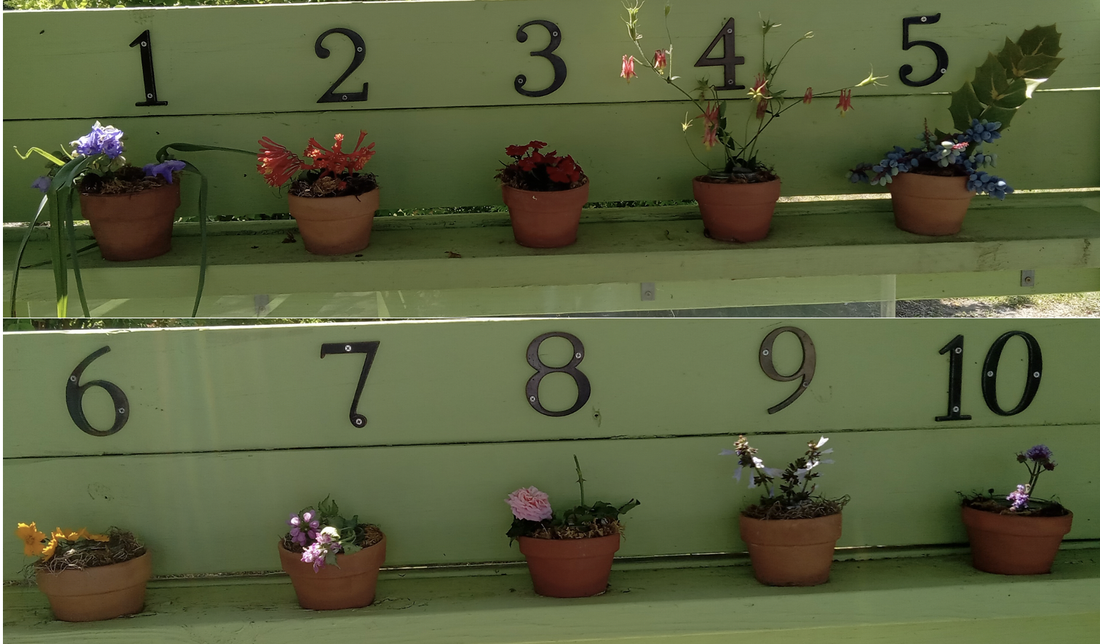
Picture

Week of April 8, 2024
Celebrating National Native Plant Month
By Teresa S., Pitt County Extension Master Gardener Volunteer
April is National Native Plant Month. Think about adding native trees, shrubs, and flowers to your garden. All plants on display today are native plants.
For more native plant ideas, check out the NC State Plant Toolbox at
https://plants.ces.ncsu.edu 


Walking Garden
1.  Chionanthus virginicus (Virginia or White Fringe Tree)
2.  Juniperus virginiana (Eastern Red Cedar)
3.  Crataegus viridis (Green Hawthorn)
4.  Aesculus pavia (Red Buckeye)
5.  Halesia tetrapteta (Carolina Silverbell)


Butterfly Garden
6.  Bignonia capreolata (Crossvine)
 

Wildflower Garden
7.  Salvia lyrata (Lyreleaf Sage)
 

Perennial Garden
8.  Baptisia alba (White Wild Indigo)
9.  Phlox subulata (Moss Phlox)
 

Wet Sites Garden
10. Itea virginica (Virginia Sweetspire)
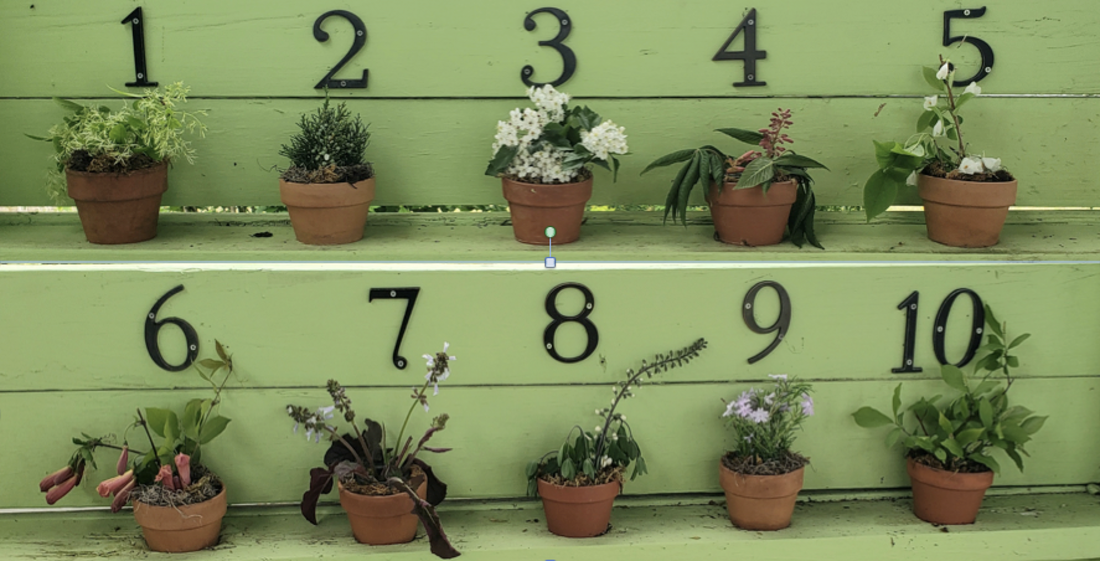

Picture

Week of April 1, 2024
Colorful blooms for everyone
By Barbara P., Pitt County Extension Master Gardener Volunteer

While the size, form, and fresh white hue of Viburnum macrocephalum - Chinese Snowball Viburnum - makes it this week's showstopper, there are blooms of all colors in the Arboretum, sure to please everyone's palette.  We're open seven days a week, from dawn to dusk. Admission is free and there's lots of free parking, too. Hope to see you.

Browse the NC State Plant Toolbox website if you would like more information on this week's plants in bloom.


Shade Garden
      1.   Hyacinthoides hispanica – Spanish Bluebells     
      2.  Polygona odoratum ‘Variegata’ pluriflorum – Striped Solomon’s Seal 
Wet Site Garden
      3.  Sabal minor – Dwarf Palmettos 
Welcome Garden
      4.  Antirrhinum majus – Snapdragons 
Butterfly Garden
     5.  Gelsemin sempervirens – Carolina Jessamine (Native plant) 
Mixed Border
     6.  Syringa ‘Penda’ – Bloomerang Reblooming Lila
Children’s Garden

     7.   Ipheion uniflorum – Spring Starflowers    
     8.   Iberis sempervirens – Evergreen Candytuff
 
Walking Trail

     9.  Viburnum macrocephalum – Chinese Snowball Viburnum
   10.  Fothergilla spp. – Fothergilla
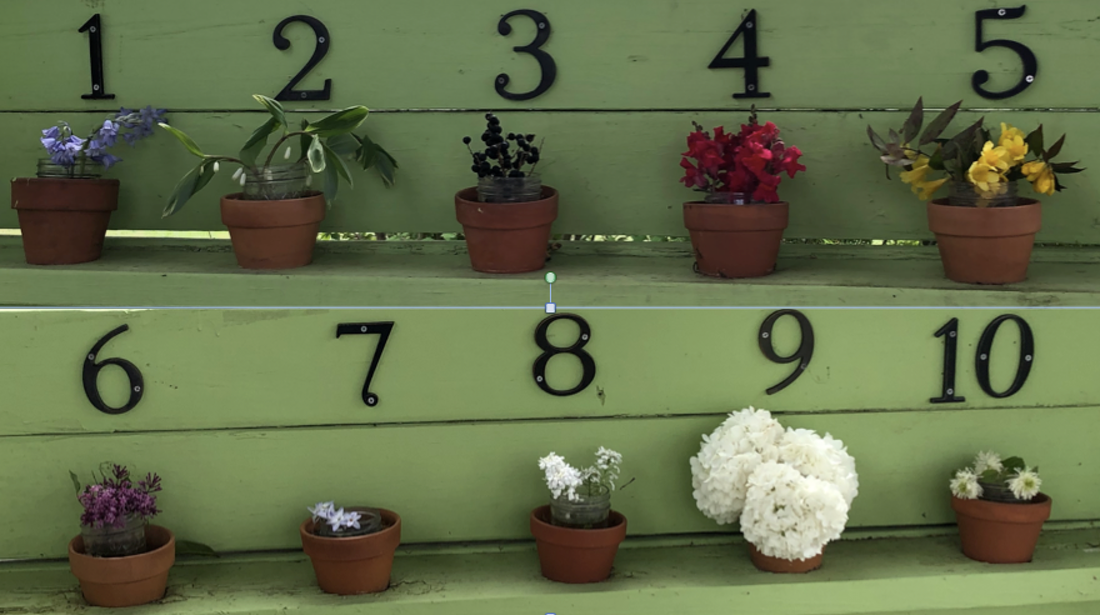
Picture

Week of March 25, 2024
Pops of color in the Gardens
By Cindy C., Pitt County Arboretum Extension Master Gardener Volunteer

Spring is here, and the gardens at the Arboretum are displaying more and more pops of yellow, pink, white, and even blue.

Consider visiting the Arboretum for a leisurely stroll around the walking trails and gardens. The Pitt County Arboretum is open seven days a week from dusk to dawn. The plants highlighted here are on display under the green canopy next to the parking lot.  If you would like more information about these plants, check out the NC State Plant Toolbox.
 
Walking Garden
1.   
Mahonia bealei                                                               Leatherleaf Mahonia                                                                 

Butterfly Garden
2.   
Gelseminum supervirens                                              Carolina Jessamine (native)       

Welcome Garden
3.   
Spiraea japonica 'Double Play Candy Corn’               Candy Corn Spirea

Memorial Garden
4.   
Loropetalum chinense                                                   Chinese Fringe Flower

Wet Site Garden
5.   
Prunus  x yedoensis                                                        Yoshino Cherry

Butterfly Garden
6.   
Cercis chinensis                                                               Chinese Redbud

Perennial Garden
7.   
Osmanthus fragrans                                                      Tea Olive
8.    Euphorbia martini ‘Ascot Rainbow'                            Spurge
9.    Pulmonaria ‘Trevi Fountain'                                        Lungwort
10.  Helleborus x hybridus Frostkiss ‘Molly’s White'      Lenten Rose
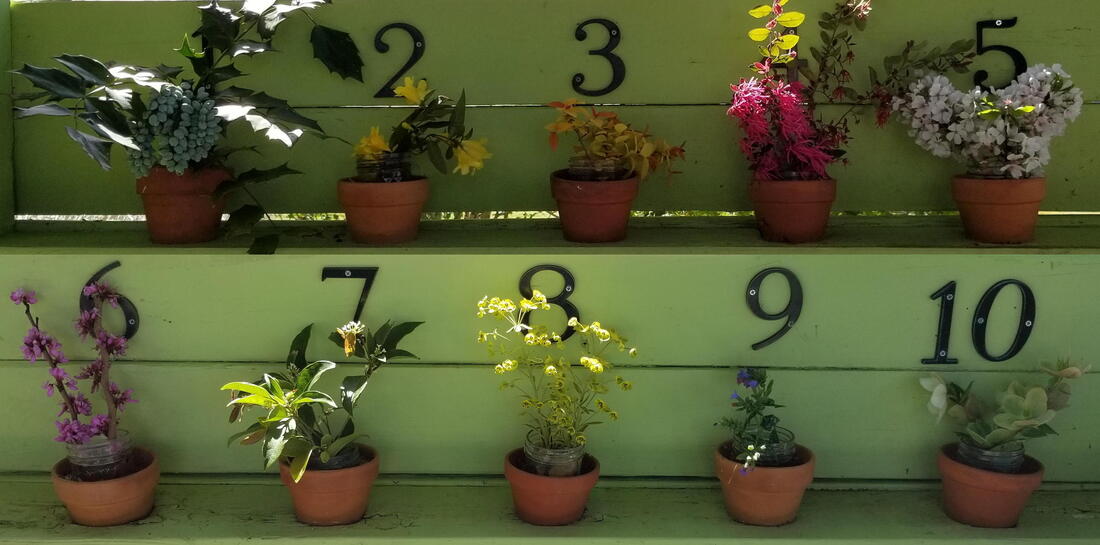
Picture

Week of March 18, 2024
Watch Spring unfold at the Arboretum
By Joanne K., Pitt County Arboretum Extension Master Gardener Volunteer,
with assistance from Master Gardener Interns, Carolyn E. and Barbara P.


Tuesday, March 19, is the official start of spring, but the Pitt County Arboretum has been abloom for several weeks.

The native trumpet honeysuckle vine in the Children's Garden, which can be spotted in woodlands and along Greenville's greenway, is covered with clusters of tubular-shaped flowers, coral on the outside and yellow inside. The flowers are magnets for the ruby-throated hummingbird.

Another native, the Columbine, with its orange and yellow coloring similar to the native honeysuckle, can be seen in the Perennial and the Shade gardens. Hummingbirds love its bell-shaped flowers.

Also in the Perennial Garden the Japanese camellia continues flowering, as do the hellebores. Both are evergreens providing year-round garden interest.

The Ostrich Ferns still sport their dry brown fronds, which are lovely for dried arrangements. Soon tiny green curled fronds will appear at the base.

In the Walking Garden, the yellow magnolia 'Butterflies' has new blooms along with the older ones that have turned a soft tan. With its mass of beautiful white balls from top to bottom, the Chinese Snowball Viburnum is always a knockout.

The variegated leaves of the Japanese Acuba and the evergreen needles of the Dwarf Japanese Euonymous needles look good all year.

The delicate blooms on the Japanese Maple look very airy in the morning light.

We invite you to visit the Arboretum and watch spring unfolding in eastern North Carolina.
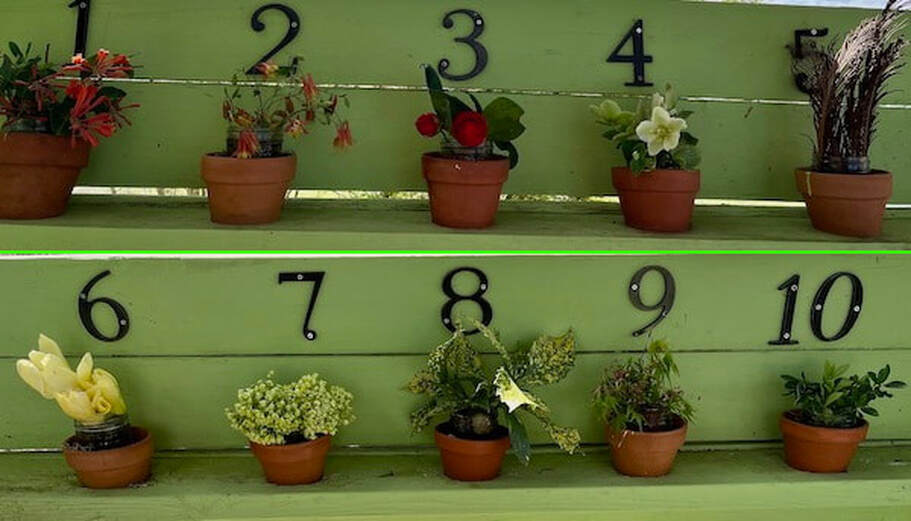
Picture
Children's Garden
1.    Lonicera semperviens, Trumpet Honeysuckle, Native     

Perennial Garden
2.    Aquilegia sp., Columbine, Native
3.    Camellia japonica, Japanese Camellia
4.    Helleborus x hybridus FROSTKISS, 'Molly's White,' Lenten Rose
5.    Matteuccia structhioptaris, 'The King,' Ostrich Fern, dried fronds    

Walking Garden
6.    Magnolia 'Butterflies,' Magnolia Hybrid
7.    Viburnum macrocephalum, Chinese Snowball Viburnum
8.    Acuba japonica, Japanese Acuba
9.    Acer palmatum, Japanese Maple
10.    Euonymous japonicus, 'Microphyllus,' Dwarf Japanese Euonymous


Week of March 11, 2024
Getting closer to spring

By Susann C., Pitt County Arboretum Extension Master Gardener Volunteer

Feeling the sun and seeing today’s bright blue sky suggests we’re that much closer to spring. Deep pink and red blooms shine at the Arboretum, whether it is the deep round dark purple berries massed over a trellis in the Children’s Garden; Moss Phlox with its delicate flowers, on the edge of the Wildflower Garden, the recovering Redbud with its striking fuschia notes in the Butterfly Garden, or the deep purple tones of the clumps of Lenten Rose in the Perennial Garden. Luckily for us, sunny warm days will accelerate the arrival of more plants in bloom, adding to the pops of color now present.

If you’d like to know more about the plants featured in What’s in Bloom, check out the NC State Plant Toolbox.
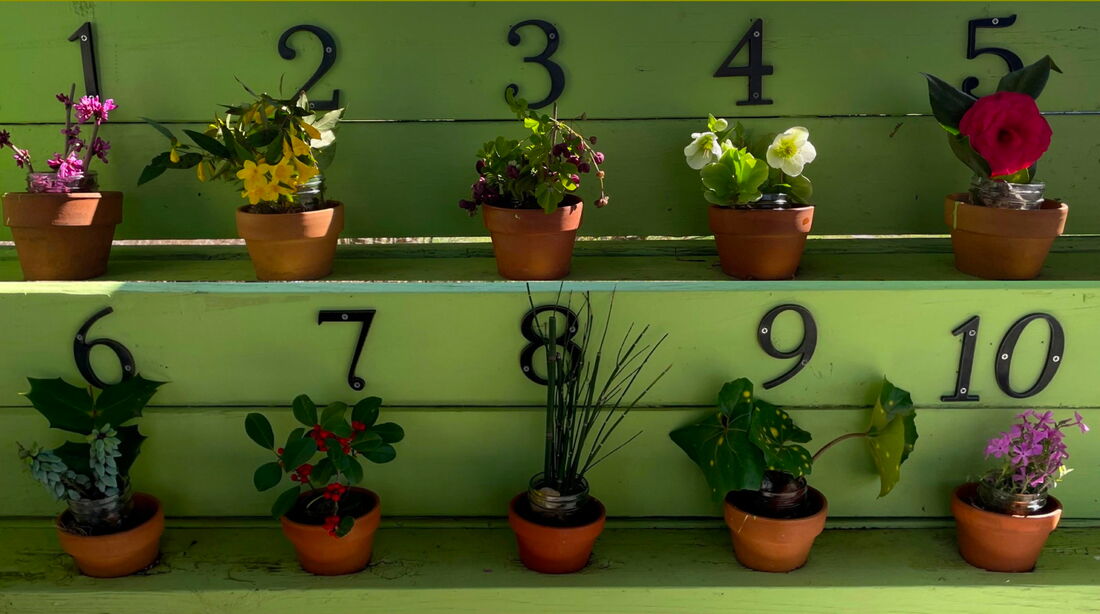
Picture
Butterfly Garden
1. Cercis chinensis – Chinese Redbud

Children’s Garden
2. Gelsemium sempervirens –Carolina jessamine (native)
3. Akebia quinata – Chcolate Vine

Perennial Garden
4.    Helleborus hybridus ‘Molly’s White’ – Molly’s White Lenten Rose

Mixed Border
5. Camellia japonica – Japanese Camellia

Walking Trail
6. Berberis bealei – Leatherleaf Mahonia
7. Ilex x attenuata ‘East Palatka’ – East Palatka Holly (native)

Wet Site
8. Equisetum hyemale – Rough Horsetail (native)
9. Farfugium japonicum – Leopard Plant

Wildflower Garden
10.    Phlox subulata – Moss Phlox (native)


Week of March 4, 2024
Late winter bloomers
by Joanne K., Pitt County Arboretum Extension Master Gardener Volunteer

With the beginning of March, What's in Bloom begins its 2024 season.
 
Late winter bloomers range from bright yellow forsythia, which comes out ahead of its leaves; the many beautiful magnolias with their varied shapes and colors; and the very fragrant osmanthus and viburnums. Beautiful bulbs such as daffodils continue to open.
 
If you look closely at the trees, you'll see the first flowers on the cherries and the buds on the native red maples that will soon burst open. Known for its beautiful variegated leaves, the aucuba surprises and delights when it sports tiny blooms this time of year.
 
Now is a wonderful time to stroll through the many Arboretum gardens to observe the approach of spring.
 
You can learn more about the plants below by looking them up in the NC State University Extension Gardener Plant Toolbox.
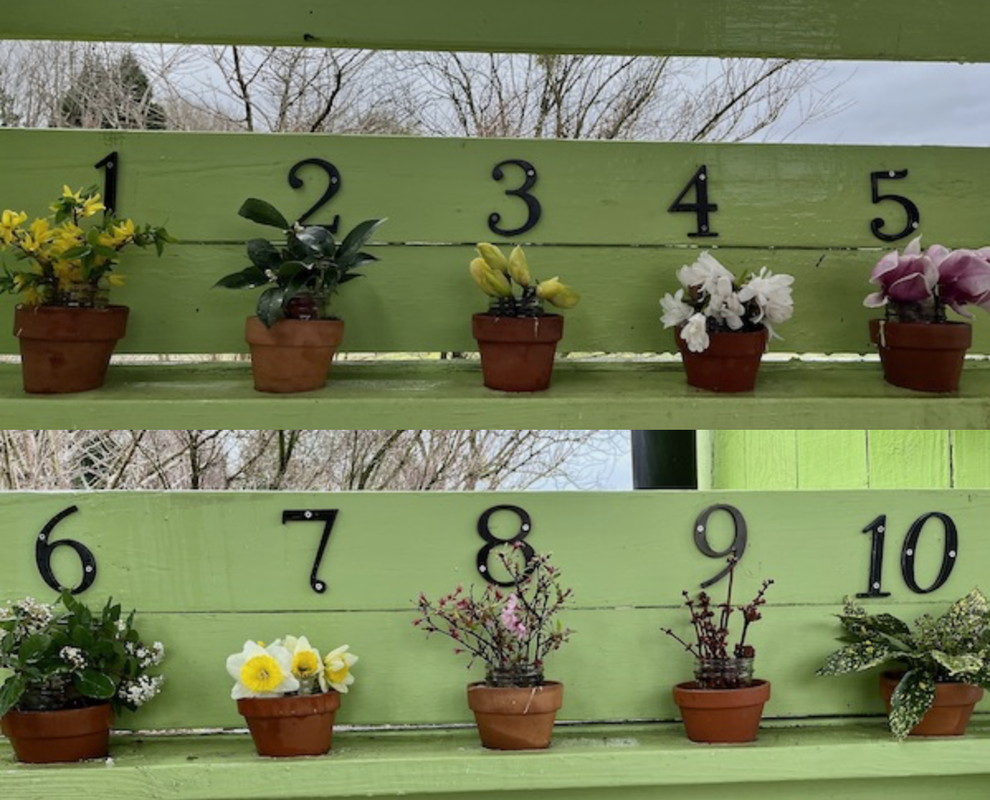
Picture
All selections are from the Walking Garden

1.      Forsythia x intermedia, Border Forsythia
 
2.      Osmanthus fragrans, Fragrant Tea Olive
 
3.      Magnolia 'Butterflies,' Hybrid Magnolia
 
4.      Magnolia stellata, Star Magnolia
 
5.      Magnolia x soulangeana, Saucer Magnolia
 
6.      Viburnum tinus, Tinus viburnum
 
7.      Narcissus 'Ice Follies,' Large-Cupped Daffodil
 
8.      Prunus x 'Okame,' Okama Hybrid Cherry
 
9.      Acer rubrum, Red Maple – native plant
 
10.    Aucuba japonica, Japanese Aucuba


Proudly powered by Weebly
  • Home
  • What's In Bloom
  • About
    • Staff
    • Master Gardeners
    • Map
    • Stay in Touch
  • Visit
    • Visitor Information
    • Visitor Etiquette
    • Tours
    • Pitt County Agricultural Center
  • Our Gardens
    • Our Gardens
  • Blog
  • Director's Choice
  • Events
    • Calendar
    • Northside Plant Walks
  • Support
    • Plant Sale
    • Friends of the Arboretum >
      • Membership
      • Giving
    • Volunteer
  • Resources
    • Guides
    • Videos
    • Photo Gallery
  • Contact